Start SAT coaching 8 to 12 weeks before your target test date, and 12 to 20 weeks before it if your score is far from your goal. That is the short answer to when to start SAT preparation, and it depends on the gap between your score and your target, not on your grade. So the real question is not “which month should we begin?” It is “which test date are we aiming for, and how many usable weeks do we have before it?” This guide gives you a start date for each remaining 2026-27 sitting, with school exams, Ramadan and university deadlines counted in.
Reading this as a parent? Jump to the section “If You Are a Parent: When to Commit and What to Check”.
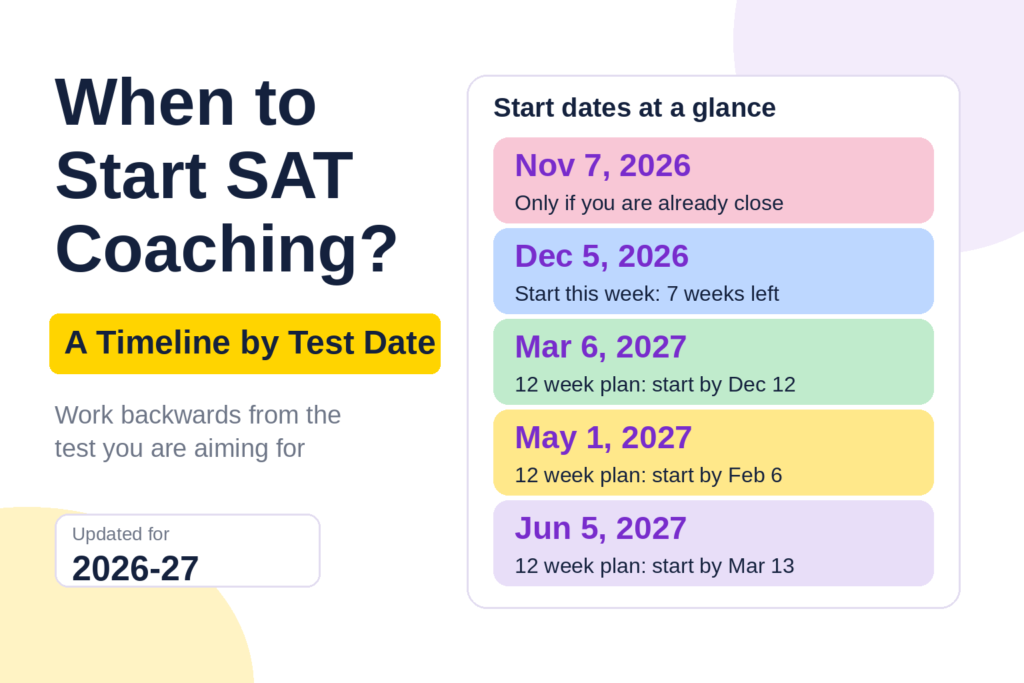
The 2026-27 timeline at a glance:
Rule of thumb: 8 to 12 weeks for a gap of 50 to 150 points, and 12 to 20 weeks for a larger gap
Gap in the calendar: no sitting between December 5 and March 6
Next dates: November 7 and December 5, 2026, then March 6, May 1 and June 5, 2027
Score release: November 20 for November 7 and December 18 for December 5, with spring dates still to be announced
Deadlines: regular registration closes at 11:59 p.m. ET, which is the next morning in the GCC
Dates and fees can change, so confirm everything against the official College Board dates page before you pay. We will not repeat that on every line below.
How Do You Work Out When to Start SAT Coaching?
Pick the test date first, then count back. A start date chosen before you know your level is a guess. A start date chosen after a diagnostic is a plan.
Four steps get you there in a weekend:
- Take a full-length practice test in Bluebook. It is free, adaptive and built like the real Digital SAT, so your total and section split give you an honest starting point. Our guide to SAT practice tests explains how to sit one properly.
- Set a target from your university list. Check each university’s admitted range and testing policy rather than picking a round number. Start with what a good SAT score is for your list.
- Measure the gap. Your target minus your latest full-length score is the number that decides how long you need.
- Count back from the test date. Subtract the weeks your gap needs, then subtract the weeks you cannot use.
Diagnostic → Gap → Weeks needed → Usable weeks → Start date
How Many Weeks Does Your Score Gap Need?
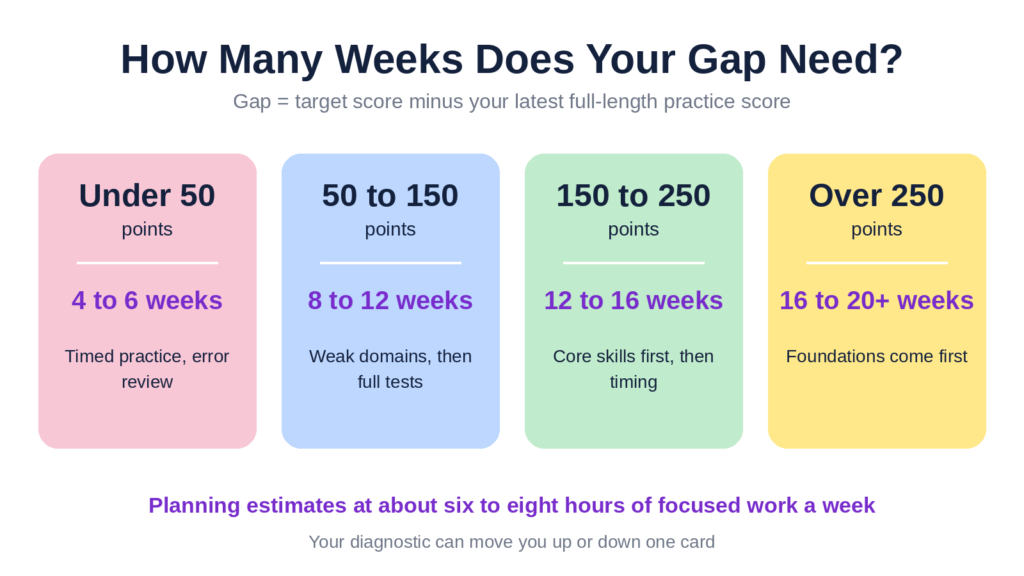
Find your gap on the left, then read across to the weeks it usually needs, assuming about six to eight hours of focused work a week.
| Your gap | Typical window | What the weeks go on |
|---|---|---|
| Under 50 points | 4 to 6 weeks | Timed practice and fixing repeat errors |
| 50 to 150 points | 8 to 12 weeks | Weak domains first, then full-length tests |
| 150 to 250 points | 12 to 16 weeks | Core skills, then timed work |
| Over 250 points | 16 to 20 weeks or more | Foundations in Reading and Writing and Math |
Read these as planning estimates, not promises. Six weeks of diagnosed, timed practice can close a small gap. Six weeks of rereading notes usually will not.
Hours matter more than months. An older College Board study of the pre-digital SAT linked 20 hours of Official SAT Practice on Khan Academy with an average gain of 115 points. That is an association, not a guarantee, but it shows where the gain comes from. Your gap tells you how many weeks you need. It does not tell you how many weeks you actually have.
What Is Your Real Study Time Once School Exams and Ramadan Are Counted?
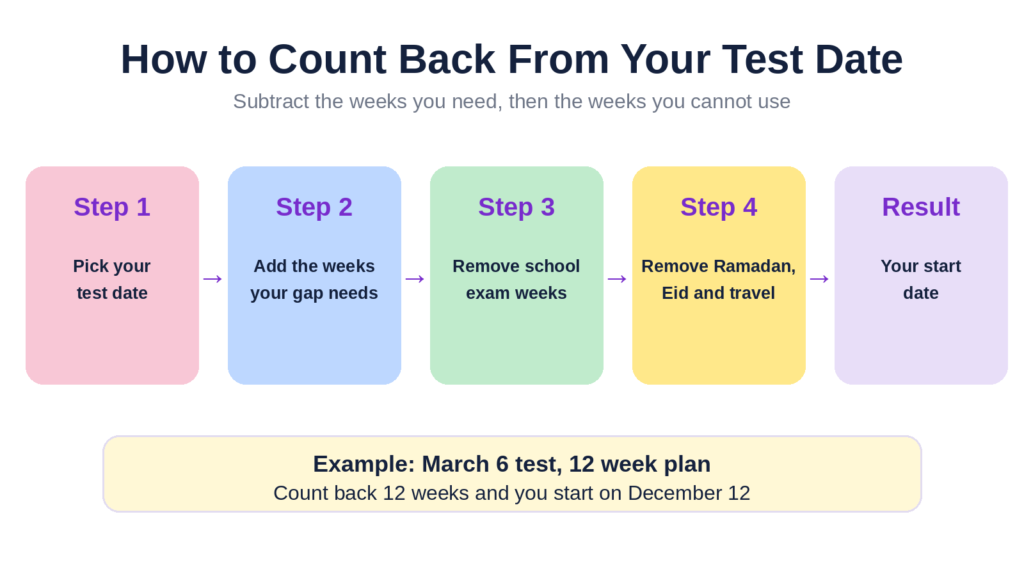
Subtract the weeks you cannot use before you decide that a plan is long enough.
Twelve calendar weeks rarely means twelve weeks of SAT preparation. Four things take time out of the plan:
- School exam weeks: IB internal assessments and mocks, A Level mocks, IGCSE papers and CBSE exams all pull study time away from the SAT, so check your school calendar before you check the SAT one
- Ramadan and Eid: Ramadan is expected to begin around February 8, 2027 and end around March 8 or 9, with Eid al-Fitr starting on March 9 or 10, and Eid al-Adha is expected around May 15 to 18, according to UAE astronomical forecasts; exact dates depend on moon sighting
- The last week: use it for light review, not new topics
- Travel and holidays: a break only counts if you actually study during it
Take a student with a 100 point gap and 12 calendar weeks. Two weeks go to school mocks and the last week goes to review. That leaves nine usable weeks, which sits inside the 8 to 12 week window with no margin to spare. Add a week of illness or travel and the plan is short.
If you fast, plan lighter study hours in Ramadan and finish your heaviest mock test work before it begins. For a test on March 6, that means counting back from February 8, which puts your start in mid-November.
Not sure which gap you are in? A free diagnostic mock test shows your total, your section split and the question types costing you the most points, so you can read your gap from the table above and count back to a start date. Built for students across the UAE and GCC preparing around a full school timetable.
→ Try a Free SAT Mock Test or Book a Free Demo
When to Start SAT Preparation for Each 2026-27 Test Date
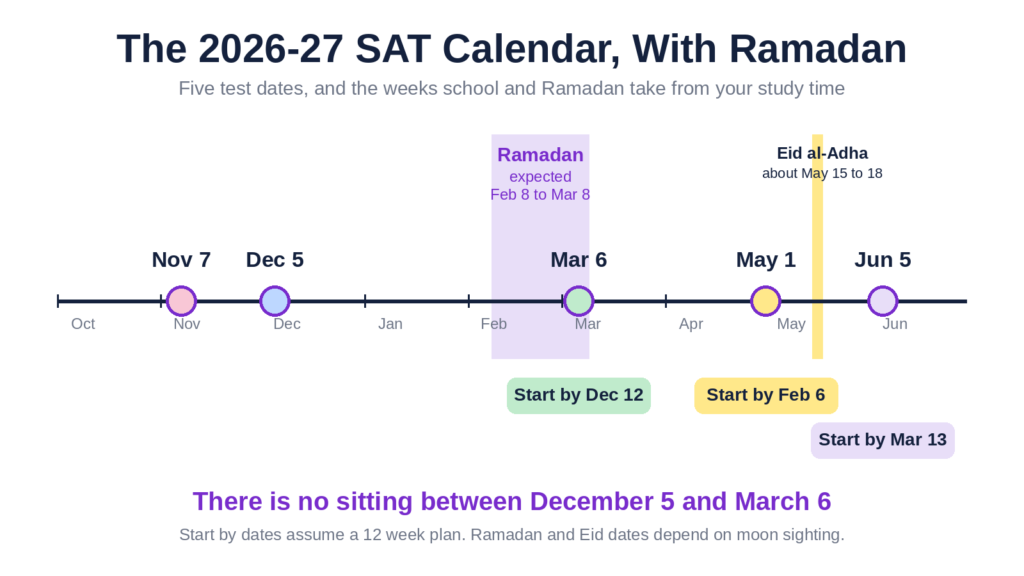
Read the start by flags as the latest sensible start for a 12 week plan, and note how much of the spring sits inside Ramadan.
The College Board publishes one schedule for students in the US and abroad. Deadlines expire at 11:59 p.m. ET, which is between 6:59 a.m. and 8:59 a.m. the next morning in the GCC, depending on your country and daylight saving time, so treat the evening before as your real deadline. Our guide to SAT test dates covers every date and fee in full.
| Test date | Register by | 12 weeks before | 16 weeks before |
|---|---|---|---|
| November 7, 2026 | October 23 | August 15 (passed) | July 18 (passed) |
| December 5, 2026 | November 20 | September 12 (passed) | August 15 (passed) |
| March 6, 2027 | February 19 | December 12 | November 14 |
| May 1, 2027 | April 16 | February 6 | January 9 |
| June 5, 2027 | May 21 | March 13 | February 13 |
Use the 12 week column for a gap of 50 to 150 points and the 16 week column for a larger one. The first two dates need a more honest answer, which follows.
November 7: only if you are already close
The regular deadline is October 23, and late registration closes October 27 for an extra $38. Scores arrive on November 20. A 12 week plan would have started in August, so this date suits only students whose latest full-length score sits within about 50 points of the target. If your gap is larger, three weeks will not close it, and a rushed first attempt costs you a full registration fee for a score you may not use.
December 5: the last realistic date for January deadlines
The regular deadline is November 20, late registration closes November 24 and scores arrive on December 18. If you start this week, you have about seven weeks, which fits a gap of under roughly 100 points. Check the date each university needs your score before you commit. If you are in Grade 12 and have not started, our answer to whether your child is too late to start SAT prep walks through the options.
The December trap. A December 18 score release can arrive after an early January deadline, and no sitting follows until March 6. A March score arrives too late for most January deadlines, so December is a one-shot date for Grade 12 applicants.
March 6: the strongest first attempt for Grade 11
The regular deadline is February 19, with late registration closing February 23. Count back 16 weeks and you start on November 14, which also finishes your heaviest mock test work before Ramadan is expected to begin on February 8. The test itself falls in the final days of Ramadan, so if you fast, weigh March 6 against May 1. A March first attempt keeps May 1 and June 5 open as retakes, and it gives a Grade 11 student a result well before Grade 12 begins.
Students in the GCC reach the top end. A SATisfactory student in Grade 11 at Brighton College, Al Ain scored a perfect 1600 on the first attempt, the highest Digital SAT score in the Middle East since 2023, as Khaleej Times reported. These are reported individual results, not guarantees for future students.
May 1: the retake window, or a first attempt with a long runway
The regular deadline is April 16, and late registration closes April 20. Count back 16 weeks and you start on January 9, which gives you a few weeks before Ramadan and then the spring term. May 1 works as a retake after a March result, or as a first attempt if you start in early January. College Board has not yet published score release dates for the spring sittings, and it states that most scores arrive within two to four weeks. Eid al-Adha is expected about two weeks after the test.
June 5: a backup, not a plan
The regular deadline is May 21, and late registration closes May 25. Count back 16 weeks and you start on February 13, in the middle of Ramadan and the spring term. June 5 also sits inside the school exam season for many students, so treat it as a safety net after March or May rather than a first attempt. A first attempt on June 5 leaves almost no room for a retake before applications begin.
Which Timeline Fits Your Situation?
Match your situation to the closest row, then let your diagnostic adjust it.
| Your situation | Test date to aim for | When to start coaching |
|---|---|---|
| Grade 12, no score yet, January deadlines | December 5 | This week, with about seven weeks left |
| Grade 12, practice score near target | November 7 | Already started; register by October 23 |
| Grade 11, applying in autumn 2027 | March 6, with May 1 as backup | By mid-November |
| Grade 11 with heavy spring exams | May 1, with June 5 as backup | By early January |
| Grade 11 aiming for the most selective US universities | March 6, then May 1 | By mid-November, so two attempts fit |
| Grade 9 or 10 | No test date yet | Build reading and algebra now, then take a diagnostic early in Grade 11 |
Read these as starting points, since a diagnostic can move any row. If you are in Grade 9 or 10, the SAT Foundation Course builds these skills without the pressure of a test date, and our grade-by-grade guide on when UAE students should take the SAT looks at the same decision by year group.
Do Testing Policies Change When You Should Start?
Sometimes, yes, and Grade 11 students feel it most. Columbia confirmed in June 2026 that it will require SAT or ACT scores from the 2027-28 admissions cycle, and it stays test-optional for 2026-27, according to its testing policy update. Harvard, Yale, Brown and MIT already require scores, and Princeton has announced the same from 2027-28.
If you are in Grade 11 now, you apply in the 2027-28 cycle. For selective US universities, that means a score is part of the application, and a plan with room for two attempts is safer than one with a single sitting. Columbia allows hardship waivers, but do not design your plan around one.
Most four-year US colleges remain test-optional, and many universities in the UAE and UK do not require the SAT at all. So the real question is not “is the SAT required everywhere?” It is “is it required where I am applying?” Check your list against the universities in the GCC accepting the SAT before you spend a term preparing.
When Is Self-Study Enough, and When Does Coaching Pay Off?
Bluebook practice tests and Khan Academy are free, so coaching has to earn its place. It does that by adding diagnosis, feedback and a schedule you actually keep, not by adding more tests. Use the comparison below to see which side you sit on.
| Self-study usually works when | Coaching usually helps when |
|---|---|
| Your gap is under 50 points | Your gap is over 100 points |
| You review every mistake without being asked | Your score has not moved after two full-length tests |
| You can hold a weekly schedule alone | Your school timetable leaves little room to plan |
| One section is the problem | Both sections need work, or the cause is unclear |
Read these as signals, not rules. If a diagnostic puts you on the left-hand side, you may not need coaching yet. A sensible order is below, and our guide to whether 1-on-1 SAT tutoring is worth it goes into cost and benefit.
Diagnostic → Two weeks of self-study → Retest → Coaching if the score has not moved
Does Your Country in the GCC Change the Start Date?
No, the test dates are the same everywhere in the region. The College Board runs one schedule, and you choose a test centre when you register. What changes is the clock and the calendar around the date. Deadlines fall an hour later in the UAE and Oman than in Saudi Arabia, Kuwait, Qatar and Bahrain, and each curriculum has its own exam season.
Regional closures are rare, but they have happened. The College Board cancelled the March 2020 sitting in the UAE, Bahrain and Kuwait, for example, as Gulf News reported. Choose one main date and one backup rather than a single sitting.
Whether you are comparing SAT prep in Dubai, Saudi Arabia, Qatar, Kuwait, Oman or Bahrain, the dates above stay the same. The weeks you can actually use depend on your own school calendar, which is why SATisfactory students set their weekly schedule with PlanPilot and move it around school exams.
If You Are a Parent: When to Commit and What to Check
Parents usually ask two things: is it too early, and is it too late? Both have a calendar answer once you know the test date.
Before you pay
- Fees: registration is $68 plus a regional fee outside the United States ($43 at the time of writing), and late registration adds $38, so a missed deadline costs more than a short wait
- Free resources: Bluebook practice tests and Khan Academy cost nothing, so a paid programme should add diagnosis, feedback and a schedule your child can keep
- Proof: ask any provider for before-and-after scores from students who started where your child starts, not only the top results
- Flexibility: ask what happens if the tutor is not the right fit, since FlexiTutor at SATisfactory lets students switch instructors at any point, and compare options on the pricing page
Questions worth asking your child
- Which universities are on your list, and do they require scores?
- Which test date fits around your school exams and Ramadan?
- What was your latest full-length practice score, and which section is lower?
- In which week would you like to stop learning new material and only review?
How to support without adding pressure
- Agree on one test date and one backup, then stop revisiting the choice
- Protect the week before the test from extra commitments
- Treat each practice score as information about what to fix, not a forecast
A first attempt is a measurement, not a final judgement.
The Bottom Line on When to Start SAT Coaching
Your gap tells you how many weeks you need. Your calendar tells you how many you have. Your test date tells you when to begin. The right answer to when to start SAT preparation is a calculation, not a feeling.
Take a diagnostic, measure the gap, count back from your test date and remove the weeks you cannot use. For a spring test that usually lands between mid-November and early January, and for December 5 it means this week.
So ask yourself one question: which test date am I aiming for, and how many usable weeks do I have before it? That question has an answer, and the answer is your start date.
Want to see your gap before you choose a date? Ask for a diagnostic before committing to any programme, including ours. Our free mock test shows your total, your section split and the question types costing you points, so you can count back from a real test date.
→ Try a Free SAT Mock Test or Book a Free Demo