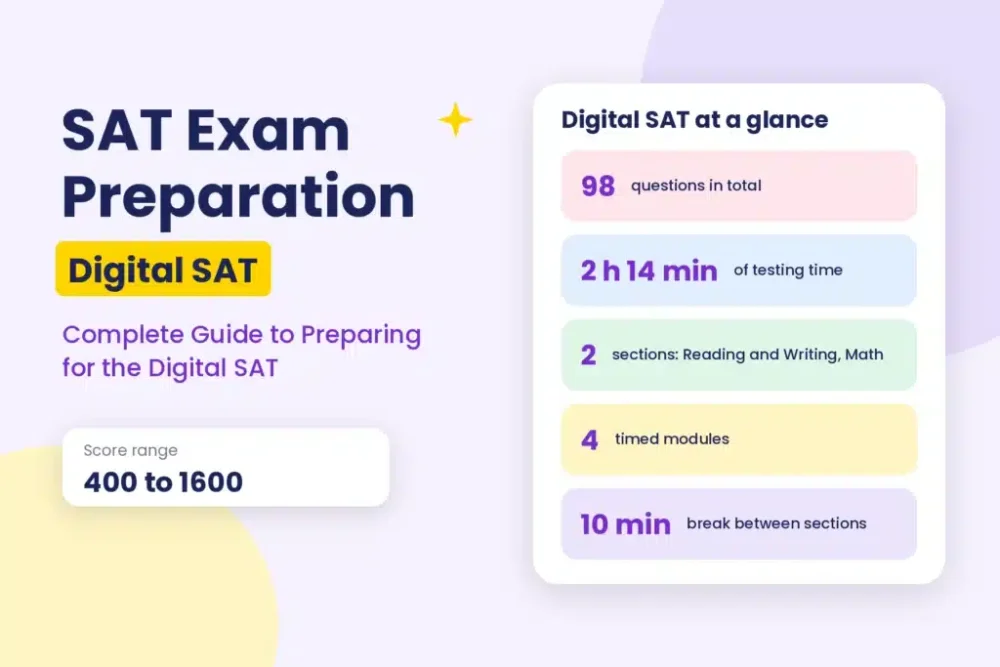
The Digital SAT has 98 questions, two sections and 2 hours 14 minutes of testing. Good SAT exam preparation for it has four steps: learn the format, take a timed diagnostic, practise in Bluebook against the clock and review every mistake. Do them in that order, over four to twelve weeks.
Most advice online skips the last step, and a lot of it describes a test that no longer exists. A guide that mentions a 65 minute reading section, a no-calculator Math section or an optional essay is written for the paper SAT. So the real question is not “how many hours should I study?” It is “what should I do this week, given my score and my test date?” This guide answers that, one step at a time.
Reading this as a parent? Jump to the section “If You Are a Parent: How to Support Without Adding Pressure“.
What Is the Digital SAT Format in 2026?
The Digital SAT is taken in the College Board’s Bluebook app on an approved laptop or tablet. It has two sections, Reading and Writing and then Math, with a 10 minute break between them. Each section has two timed modules, so the whole test is four modules and 98 questions.
| Section | Modules | Questions | Time |
|---|---|---|---|
| Reading and Writing | 2 | 54 | 64 minutes (two 32 minute modules) |
| Math | 2 | 44 | 70 minutes (two 35 minute modules) |
| Total | 4 | 98 | 2 hours 14 minutes |
Scores run from 400 to 1600, made up of two section scores from 200 to 800. Read the table as the frame for everything below: your study plan has to fit these four modules.
Two details change how you prepare. Reading and Writing uses short passages, usually with one question each, not the long passages of the paper test. Math allows a calculator on every question, with a built-in graphing calculator in Bluebook and a reference sheet on screen.
The paper SAT trap If a guide mentions a 65 minute reading section, a no-calculator Math section or an optional essay, it describes the paper test. None of those exist on the Digital SAT. Check any guide against the format above before you follow its advice.
That format has one feature that changes how you practise: it adapts.
How Does the Adaptive Format Change SAT Exam Preparation?
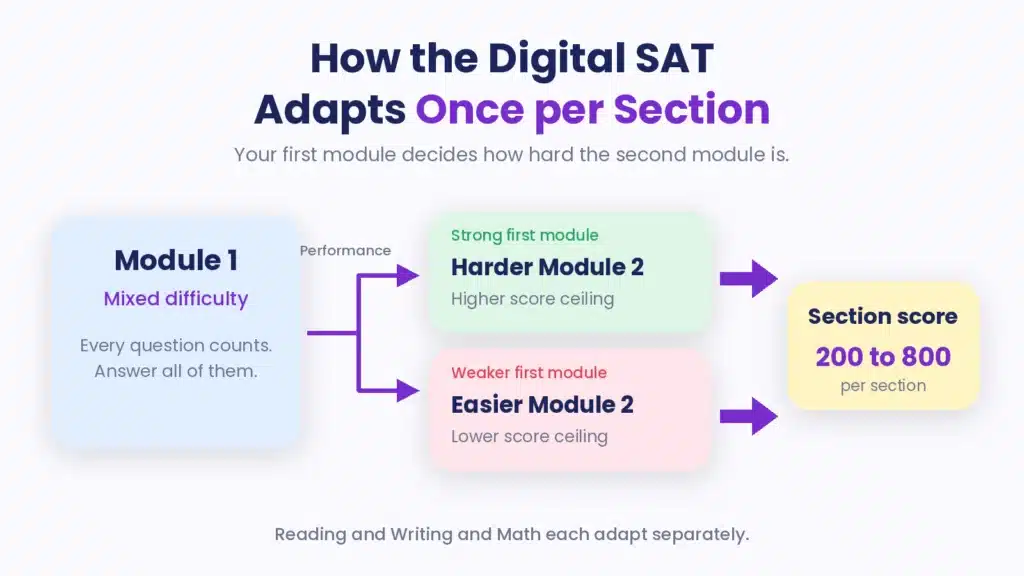
Each section adapts once, between its two modules. Your performance in the first module decides whether the second module is easier or harder. The test does not adapt question by question.
This is why the first module of each section matters most. A weaker first module usually leads to the easier second module, and that can limit how high your section score goes. You cannot see which module you are in, so treat every question in module one as the one that counts.
Two habits follow from this. First, practise on full adaptive tests in Bluebook, not only on loose question sets, so that you feel the jump in difficulty. Second, answer every question. The Digital SAT does not penalise wrong answers, and you can flag a question and return to it before the module closes.
What Does the Digital SAT Actually Test?
Each section is built from four content domains. Knowing the domains tells you where your practice time should go.
| Section | Domain | What it covers | Approximate share |
|---|---|---|---|
| Reading and Writing | Craft and Structure | Vocabulary in context, text structure, purpose | About 28% |
| Reading and Writing | Information and Ideas | Main ideas, evidence, inferences, data | About 26% |
| Reading and Writing | Standard English Conventions | Grammar, punctuation, sentence structure | About 26% |
| Reading and Writing | Expression of Ideas | Transitions, rhetorical synthesis | About 20% |
| Math | Algebra | Linear equations, systems, inequalities | About 35% |
| Math | Advanced Math | Quadratics, polynomials, exponentials | About 35% |
| Math | Problem-Solving and Data Analysis | Ratios, percentages, statistics | About 15% |
| Math | Geometry and Trigonometry | Area, volume, circles, triangles | About 15% |
Read the shares as approximate. The official College Board Digital SAT page lists the current ranges. Two things stand out. Algebra and Advanced Math together make up roughly 70 percent of the Math section. And Standard English Conventions is the most learnable part of Reading and Writing, because the rules repeat.
How Do You Find Your Starting Point?
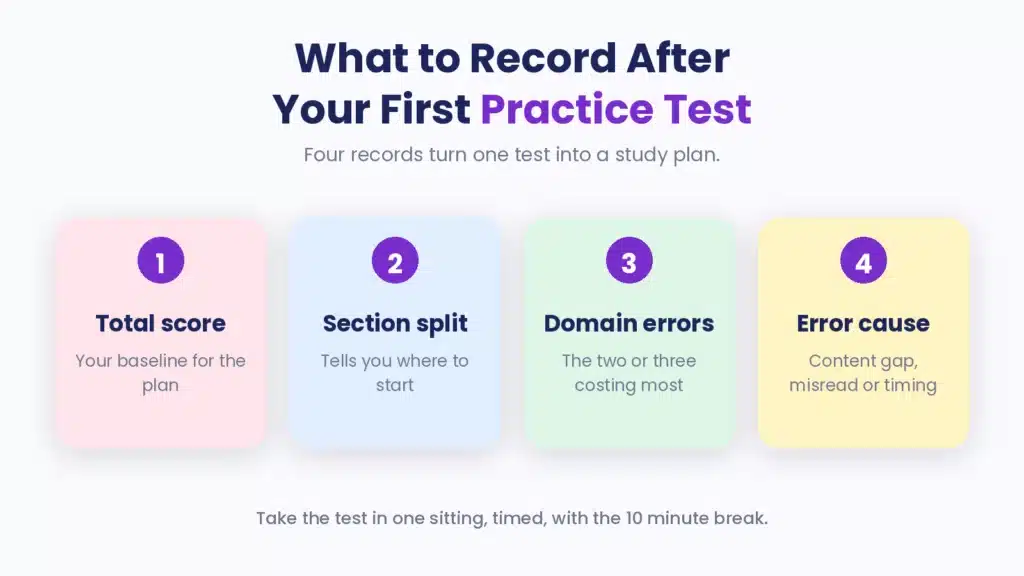
Take one full-length adaptive practice test in Bluebook under real conditions: one sitting, timed, with the 10 minute break. A diagnostic taken in pieces, with pauses, tells you very little. Then record four things.
- Total score: your baseline for the whole plan.
- Section split: which section to start with.
- Domain errors: which of the eight domains cost you the most points.
- Error cause: whether each lost point was a content gap, a misread question or a timing error.
Here is how that works in practice. Student A scores 1180: 560 in Reading and Writing and 620 in Math. Most of the lost Reading and Writing points are rushed Standard English Conventions questions, so Student A starts there, because rules can be learned in weeks. Student B also scores 1180, with 620 in Reading and Writing and 560 in Math. Most of the lost Math points are Advanced Math content gaps, so Student B starts with algebra review. The same total gives two different first four weeks.
Skip the diagnostic and start with whatever chapter comes next, and you will usually spend the first three weeks on things you already know.
How Many Weeks Do You Need Before Test Day?
It depends on the gap between your latest practice score and your target, and on how much of the calendar your school takes. Read these as planning estimates, not promises.
| Gap to your target | Realistic window | Why |
|---|---|---|
| Under 50 points | Roughly four to eight weeks | A few question types and timing |
| 50 to 150 points | Roughly eight to twelve weeks | Domain repair plus timed practice |
| More than 150 points | Three months or more | Content gaps come first |
Count only the weeks you can actually study. Exam periods, school trips and holidays remove more time than most students expect.
Then match the window to a test date. The next SAT is November 7, with a regular registration deadline of October 23. Later options are December 5, March 6, May 1 and June 5. A student reading this in mid October has roughly nine days to register and about three weeks to prepare, which is tight for almost everyone and realistic only if practice scores are already close to target. Everyone else should look at December or the spring dates. Our SAT test dates guide walks through each one.
Dates and deadlines can change, so confirm everything against the official College Board schedule before you pay. We will not repeat that on every line below.
Starting early leaves room for a second attempt. A Grade 11 student at Brighton College, Al Ain, scored a perfect 1600, the highest result in the Middle East since 2023. That is a reported individual result, not a guarantee for future students.
What Does a Week of SAT Exam Preparation Look Like?
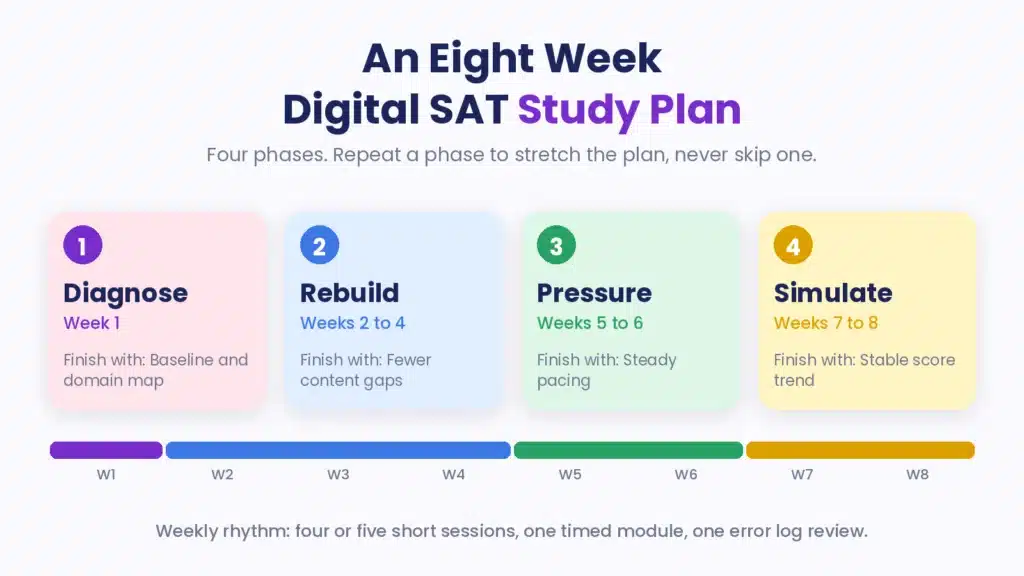
A good plan has four phases. The table shows an eight week version. To stretch it, repeat a phase. To shrink it, shorten each phase. Do not skip the diagnostic or the review.
| Phase | Weeks | Main focus | You finish with |
|---|---|---|---|
| Diagnose | Week 1 | Full practice test, error log set up | Baseline and domain map |
| Rebuild | Weeks 2 to 4 | Content review in your two weakest domains | Fewer content gaps |
| Pressure | Weeks 5 to 6 | Timed modules, mixed difficulty | Steady pacing |
| Simulate | Weeks 7 to 8 | One full test a week, then a light final review | A stable score trend |
Every phase follows the same loop.
A practical sequence: Diagnostic → Skill Review → Targeted Practice → Timed Practice → Full-Length Test → Final Review
For the weekly rhythm, most students do well with four or five short sessions of 45 to 60 minutes, one timed module on a weekday and one error log review at the weekend. The review is where the points come from. Four weeks of diagnosed, reviewed practice can move a score. Four weeks of repeating untimed questions usually will not.
Not sure which phase you are in?A free diagnostic shows your total, your section split and the domains costing you the most points, so you can place yourself in the plan above. Built for students across the UAE and GCC preparing around a full school timetable. Rated 4.9 by students and parents. → Try a Free SAT Mock Test or Book a Free Demo
How Should You Practise Each Section?
Start with the clock. Each module gives you a fixed number of minutes, so each question has a rough budget.
| Section | Questions per module | Minutes per module | Rough time per question |
|---|---|---|---|
| Reading and Writing | 27 | 32 | About 70 seconds |
| Math | 22 | 35 | About 95 seconds |
The counts include a small number of unscored pretest questions. Treat the times as averages: easy questions should take less so that hard ones can take more.
Reading and Writing
Short passages reward one habit: answer what the question asks, using only what the text says. Check each answer choice against the passage, not against your memory. Wrong choices are usually wrong for a specific reason, such as being too extreme, off topic or unsupported. Practice the Conventions rules until they are automatic, then spend the time you save on Craft and Structure and Information and Ideas.
Math
Because a calculator is allowed on every question, mental arithmetic matters less than it did on the paper test. What matters is knowing when the built-in graphing calculator saves time, such as finding where two lines meet, and when it wastes time, such as simple arithmetic. Keep algebra fluent, because most lost points come from setting the problem up, not from the calculation. Some questions have no answer choices, so practise entering answers in the right format.
Which Resources Are Worth Using?
Start with official material, because it matches the real test. Add anything else only when you run out of official questions or need feedback you cannot give yourself.
| Resource | Best for | Limit |
|---|---|---|
| Bluebook practice tests | Real format and adaptive routing | A limited supply of full tests |
| Student Question Bank | Official questions by domain | No pacing or routing |
| Khan Academy | Free lessons and drills | You still need your own plan |
| Third-party mock tests | Extra full-length practice | Quality varies; check they adapt |
| Tutor or programme | Feedback on your own errors | Costs money; fit varies |
Use the official Digital SAT sample questions to see the question styles before your first full test.
When Does Self-Study Work, and When Do You Need Help?
Self-study works for SAT exam preparation when you can diagnose your own errors honestly and keep a schedule without reminders. Many students can. Help earns its fee in three situations: your score has stalled across several tests, you cannot tell why you lose points, or your school timetable leaves too little time to plan.
If you are comparing SAT prep in Dubai or elsewhere in the GCC, look for three things: a diagnostic by domain, adaptive proctored mock tests and a tutor who teaches from your error log. One Grade 11 student from Swiss International School Qatar, who scored 1540, said the proctored tests helped with the SAT’s structure, pacing and exam environment.
SATisfactory’s SmartMocks adjust difficulty and give weekly updates, PlanPilot lets you set your own schedule and FlexiTutor lets you change instructors at any time. Our Accelerator Program is for Grades 11 and 12, and students in Grades 9 and 10 can start earlier with the Foundation Course. Ask for a diagnostic before committing to any programme, including ours.
Which Mistakes Waste the Most Preparation Time?
Five mistakes cost students the most time. Check your own plan against them.
- Practising on paper PDFs: this builds habits for a test that no longer exists.
- Skipping review: a full test with no review wastes 2 hours and 14 minutes.
- Practising only your strengths: points are cheaper in weak domains than in strong ones.
- Changing method every week: give a method three or four sessions before you judge it.
- Cramming the night before: sleep is worth more than one more module.
A practice score tells you where you are. Your error log tells you why.
What Should You Do in the Final Week and on Test Day?
The last week is for stability, not new material.
- Complete the device readiness check in Bluebook and charge your device
- Confirm your test centre, your route and your arrival time
- Pack photo ID and anything College Board lists as required, such as your admission ticket
- Take one timed module three days before, not a full test
- Sleep normally and avoid learning new topics
- On the day, flag hard questions and move on, and use the break to eat and drink
The plan only works if the basics are ready, so settle them early.
If You Are a Parent: How to Support Without Adding Pressure
What helps most
- Agree the test date and the weekly study hours once, then stop reopening the question
- Protect the study blocks around school exams
- Ask about the error log, not only the score
- Avoid comparing your child with other students
- Arrange the device, the route and the registration early
Questions worth asking your child
- Which domain cost you the most points this week?
- What will you change in next week’s plan?
- Do you need a different kind of help?
- Is the test date still the right one?
Before you pay
Registration for international students has been $68 plus a $43 international fee at the time of writing, so confirm the current total on College Board. If you are choosing a programme, read our guide to what a high-score programme should include before you compare fees.
The Bottom Line on SAT Exam Preparation
Preparing for the Digital SAT is a sequencing problem, not a motivation problem. The format tells you what the test is. Your diagnosis tells you where you stand. Your plan tells you what to do this week. Your error log tells you whether it is working.
Learn the format, take a timed diagnostic, choose a test date, then work backwards week by week. If your target is not yet clear, check what a good SAT score is for your university list first.
“What is the one thing I will do differently this week?”
That question has an answer, and the answer is your next study session.
Want to know where you stand before you plan? Take a free adaptive mock to see your total, section split and weakest domains. Then book a demo to build a plan around your school timetable and test date. If the plan does not suit you, you will still have the report. For more information or assistance, contact our team.