
A stuck Math score usually comes from one or two of the four domains, not from the whole section. So the real question is not “how many SAT math problems should I solve?” It is “which topic, at which difficulty level, is costing me points?” This guide shows what each domain tests, what makes a question easy or hard, and how to practise so your score moves.
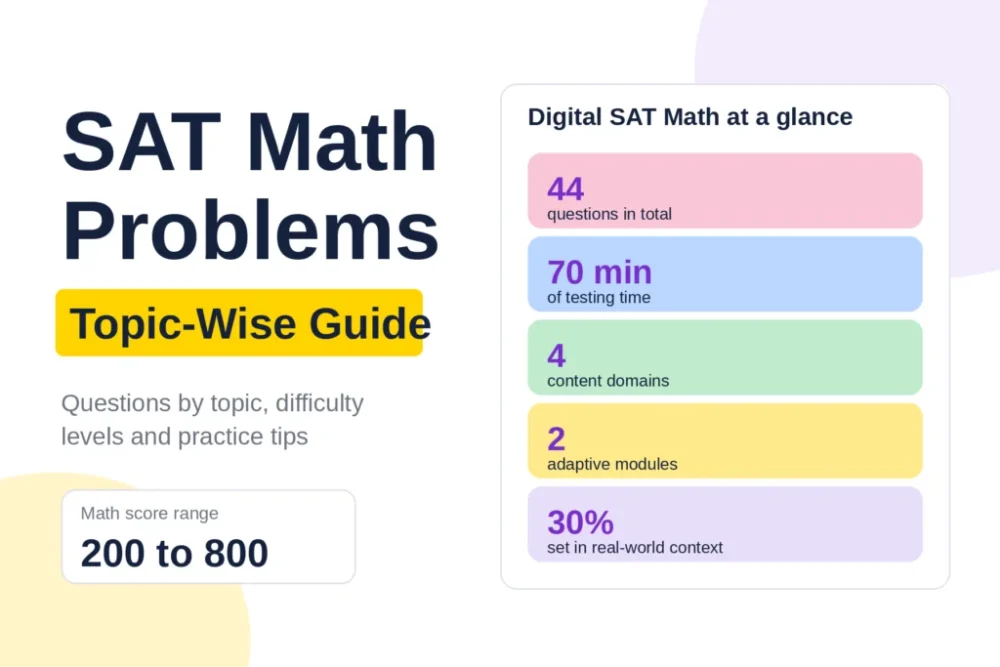
The Math section at a glance: 44 questions in two modules of 22, with 35 minutes per module. Scored 200 to 800. About 75 percent are multiple choice and the rest are student-produced responses, with a calculator allowed throughout. Details can change, so confirm them on the official College Board Math specifications. We will not repeat that below.
What Do SAT Math Questions Actually Cover?
SAT math problems come from four content domains, and every module draws from all four. About 30 percent are set in a real-world context. Algebra and Advanced Math together make up roughly 70 percent of the section.
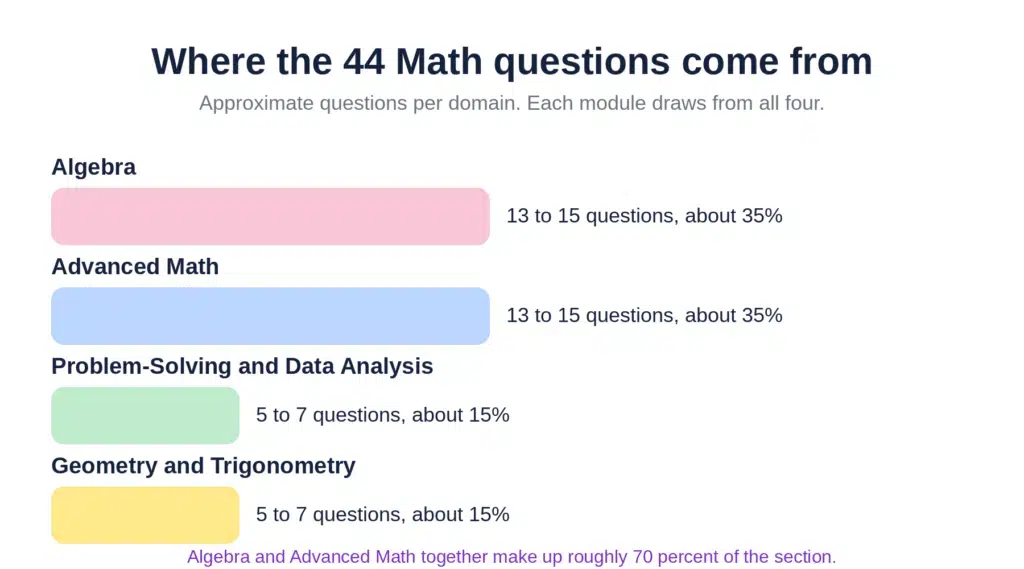
| Domain | Questions | What it tests |
|---|---|---|
| Algebra | 13 to 15 | Linear equations, inequalities, systems |
| Advanced Math | 13 to 15 | Quadratics, polynomials, exponentials, functions |
| Problem-Solving and Data Analysis | 5 to 7 | Ratios, percentages, statistics, tables |
| Geometry and Trigonometry | 5 to 7 | Area, volume, circles, triangles, trigonometry |
Read the weights as a priority order. A weak Geometry and Trigonometry area costs you six or seven questions at most. A weak Advanced Math area can cost twice that. Two questions per module are unscored pretest items, and you cannot tell which, so treat every question as real.
Topic-Wise SAT Math Problems With Worked Solutions
Try each problem before reading the solution, with about 95 seconds as your limit, the average time per question.
Algebra problem (easy)
Problem: A tutor charges a $40 registration fee plus $25 per session. A student pays $215 in total. How many sessions did the student book?
Solution: Write 40 + 25s = 215. Subtract 40 to get 25s = 175, so s = 7.
Most lost points here come from building the equation, not solving it.
Advanced Math problem (medium)
Problem: What is the minimum value of f(x) = 2x² − 12x + 7?
Solution: The vertex is at x = 12 ÷ 4 = 3, and f(3) = 18 − 36 + 7 = −11. The answer is −11.
Medium questions often hide a standard idea, here the vertex.
Problem-Solving and Data Analysis problem (medium)
Problem: The mean of five test scores is 78. After a sixth score is added, the mean is 80. What is the sixth score?
Solution: Five scores total 390 and six scores total 480, so the sixth score is 90.
Work with totals, not means, whenever a mean changes.
Geometry and Trigonometry problem (hard)
Problem: The equation x² + y² − 6x + 4y = 12 defines a circle. What is its radius?
Solution: Complete the square to get (x − 3)² + (y + 2)² = 25. The radius is 5.
Circle equations belong to this domain but need algebra to solve.
Missed one of these four? A free diagnostic mock test shows your Math score, the domains losing you the most points and how you perform at each difficulty level. Built for students across the UAE and GCC preparing around a full school timetable. Rated 4.9 by students and parents. → Try a Free SAT Mock Test or Book a Free Demo
What Makes a Math Question Easy, Medium or Hard?
Easy, medium and hard SAT math problems differ by the number of steps, how abstract the values are and how easy the traps are, not by topic. Any domain can produce any level.
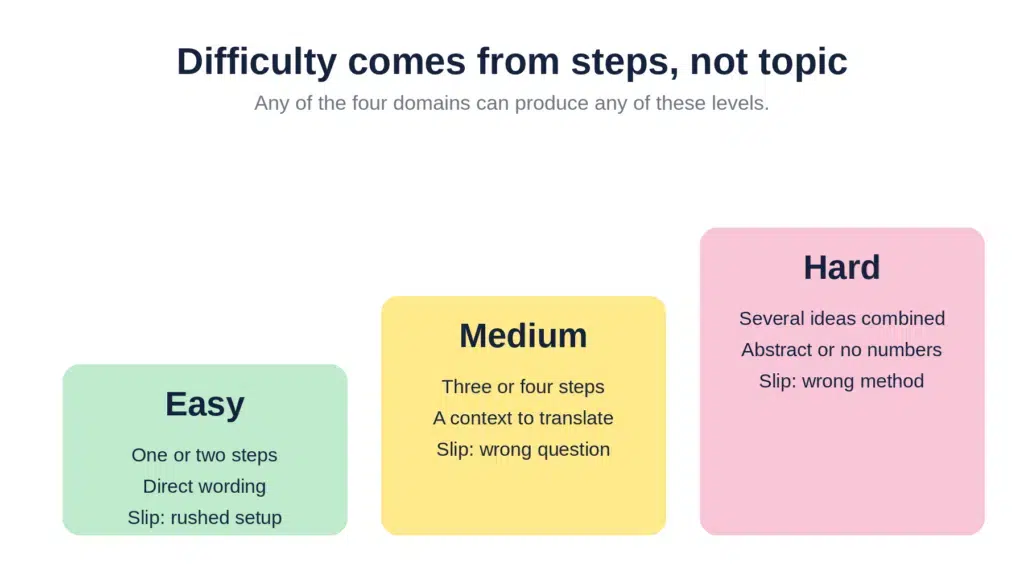
| Level | What it looks like | Typical slip |
|---|---|---|
| Easy | One or two steps, direct wording | Rushed setup or a sign error |
| Medium | Three or four steps, a context to translate | Answering a different question |
| Hard | Several ideas combined, abstract values | Time lost on a method that does not fit |
Two structural facts matter. Within each module, questions run from easiest to hardest, so an early question that eats your time is a signal to flag it and move on. The first module mixes easy, medium and hard questions, and the second becomes easier or harder depending on how you did. So module one accuracy comes first.
How Should You Practise Each Week?
Four weeks of diagnosed practice can move a score. Four weeks of repeating comfortable topics usually will not.
| Week | Main focus | What to review |
|---|---|---|
| 1 | Baseline | One timed Math section, every miss logged by domain |
| 2 | Weakest domain | Easy and medium problems, untimed then timed |
| 3 | Hard problems | Your top two weak areas, in mixed sets |
| 4 | Full simulation | One timed full-length test and every error |
- Log the cause: mark each miss as a concept gap, a setup error, a calculation slip or a time problem
- Use the calculator selectively: graphing helps with intersections, but some questions are faster by hand
- Redo missed problems after a week: if you cannot solve one cold, you remembered the answer, not the method
- Practise grid-in answers: with no options to check against, enter exact values and watch your signs
Use official problems: Bluebook practice tests, the Student Question Bank and Khan Academy practice.
Timed practice changes pacing. Nelo Akuanyionwu (1540, Swiss International School, Qatar) said proctored tests helped with pacing and exam conditions. This is a reported individual result, not a guarantee.
If You Are a Parent: How to Support Math Practice
Ask for the error log, not the score. Three questions open a better conversation than “what did you get?”
- Which domain did you miss most this week?
- Was that a concept, a setup or a time problem?
- What will you practise first tomorrow?
Your child’s score is a result, not a verdict. If your child is in Grade 9 or 10, the SAT Foundation Course builds these skills early.
The Bottom Line on SAT Math Problems
SAT math problems are a tool for finding a weakness, not a number to collect. Your total tells you where you finished. Your domain split tells you what to fix. Your difficulty level tells you how to fix it.
Test → Diagnose → Practise → Review → Retest. Set your target with what a good SAT score is and count your weeks with the SAT test dates.
“Which one domain and which one difficulty level cost me the most points last week?”
That question has an answer, and the answer tells you what to practise next.
Want a Math diagnostic before committing to anything? Ask for a diagnostic before committing to any programme, including ours. The free mock test gives you a Math score, a domain split and the question types costing you points. For more information or assistance, contact our team.