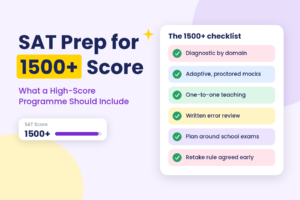

1. Starting Without a Diagnostic Test
One of the most avoidable SAT preparation mistakes is jumping straight into content review without first running a full-length practice test. Without a baseline score, there is no way to know which topics are actually costing points and which are already solid enough to leave alone.
A full diagnostic on the Bluebook app does two things at once. It gives you a starting score and it gives you a breakdown by topic so that every hour of study from that point forward is directed at the actual gaps.
What to do instead: Take a complete Bluebook practice test before opening any prep materials. SATisfactory’s free SmartMock mirrors the adaptive Bluebook experience and gives you a full section-level score breakdown in under two hours, so you know exactly where to start.
2. Using Old Paper SAT Materials for the Digital SAT
The Digital SAT is a genuinely different test from the paper SAT that most prep books were written for. It is shorter. It is adaptive. It runs through the Bluebook app on a screen. Using pre-2023 practice books or old paper-based exams to prepare for it is one of the most common digital SAT mistakes UAE students make, and it is more damaging than it looks.
The adaptive structure means the difficulty of the second module in each section adjusts based on how you performed in the first. A practice test that does not adapt gives you an inaccurate score estimate and leaves you unprepared for the actual test-day experience.
What to do instead: Use official Bluebook practice tests and adaptive SmartMocks as your primary practice resources. The format you train on should be as close to the real test as possible.
3. Doing All Practice Untimed
Understanding how to solve a problem is only one part of what the SAT tests. The other part is whether you can solve it accurately under time pressure. Many students build strong content knowledge through untimed drills and then find on test day that the clock changes everything.
This is one of the most costly SAT test day mistakes because it is invisible during prep and only becomes obvious when there is no time left to fix it.
What to do instead: What to do instead: introduce timed practice from early in your prep window, not just at the end. These are practical SAT exam tips UAE students can use to become comfortable with time pressure. Start with short timed sets at the topic level, then timed full sections, followed by full-length Bluebook tests. The pressure of test day should feel familiar rather than foreign.
4. Skipping the Review Session After Practice Tests

Finishing a practice test and moving directly to the next one is one of the most common SAT preparation mistakes, especially for students under time pressure. The test result on its own tells you almost nothing useful. The review session is where actual score improvement comes from.
Every wrong answer is specific information about a gap, whether in content understanding, test strategy, or time management. Without working back through each one carefully, the same mistakes tend to appear on every future test.
What to do instead: Schedule a dedicated review session after every practice test. Go back to each wrong answer, identify the precise reason it went wrong, and work through the concept until the underlying gap is genuinely closed.
5. Studying Topics in the Wrong Order
It feels natural to start with familiar material, the topics that feel more comfortable to review. But those are rarely the ones costing the most points. The diagnostic test tells you exactly which areas are weakest, and those are the ones that deserve the most time, even if they feel uncomfortable to sit with.
This gap between where effort goes and where it is actually needed is one of the quieter SAT preparation tips UAE students can benefit from, but it is something that experienced tutors catch quickly and students on their own rarely identify.
What to do instead: After your diagnosis, rank your topics by their impact on your current score. The most uncomfortable topic on that list is the first one to schedule, not the last.
6. Treating the Bluebook App as an Afterthought
The Bluebook app is not just where the real SAT is delivered. It is where your practice should happen too. The on-screen tools, the annotation and highlighting features, the built-in calculator, and the per-module countdown timer are all part of the test experience. Students who practise entirely on paper and then encounter the Bluebook interface for the first time on test day often find the environment itself is a distraction at exactly the wrong moment.
What to do instead: Run all timed practice tests inside Bluebook. Become fluent with the tools before test day so that when it counts, the only thing occupying your attention is the questions in front of you.
7. Not Understanding How the Adaptive Structure Works
The Digital SAT adjusts the difficulty of the second module in each section based on your performance in the first. Doing well in the first module routes you to the harder second module, which gives access to the higher end of the score range. A weaker first module routes you to an easier second module where the maximum possible score in that section is capped.
Most students who have not been told this do not know it exists, and it changes how the first module should be approached. Rushing through it or giving up on a difficult stretch during that module can quietly limit your score ceiling before the second module even begins.
What to do instead: Learn how the adaptive structure works before your first full practice test. SATisfactory’s SmartMocks replicate this adaptive experience so that the real test feels familiar, not surprising.
8. Letting School Terms Break the Prep Momentum
UAE students are managing a school calendar that does not align with the US school year. IGCSE coursework, IB internal assessments, A-Level mock exams, and UAE holiday terms all affect how much realistic study time is available each week. When a heavy school week arrives and SAT prep disappears entirely, the sessions that follow tend to involve guilt-driven cramming that rarely makes up for the gap and often leaves students more fatigued than when they started.
Plan for light prep weeks rather than lost ones. A single 30-minute Bluebook review session during a demanding school week keeps momentum and retention going without adding real pressure. For students whose schedules shift often, SATisfactory’s FlexiTutor system allows tutoring sessions to move around school commitments without losing the overall structure of the plan.
Before locking in your prep schedule, make sure your test date is set. Our SAT exam dates UAE 2026 guide maps every College Board sitting against the UAE school calendar so you can choose a date that works with your term, not against it.
What to do instead: For more on building a prep schedule around the UAE academic calendar specifically, the guide to how to prepare for SAT UAE covers the week-by-week structure that SATisfactory students across the GCC follow.
9. Cramming in the Final Two Weeks
The instinct to push hardest right before the test is understandable, but the two weeks before the SAT are actually one of the riskier points in the prep window to dramatically increase intensity. Heavy cramming at the end of a long prep cycle tends to produce fatigue more reliably than it produces score improvement. Students who arrive on test morning mentally drained make more careless errors, read more slowly, and lose concentration more easily than the underlying gap in their content knowledge would explain.
What to do instead: Use the final two weeks for full-length Bluebook practice tests, light review of your most consistent error patterns, and deliberate rest. By this point, the score has largely been shaped by what happened in the months before. The final phase is about arriving sharp, not arriving exhausted.
10. Setting a Score Target Without Knowing What Your Universities Need
Many UAE students set a SAT score goal of 1400 or 1500 without checking what the universities they are actually applying to are looking for. Some schools have median SAT ranges in the 1200s. Others require 1550 or higher for genuine competitive consideration. An arbitrary target can lead to under-preparing for some schools and over-stressing for others simultaneously.
For students focused on SAT score improvement UAE as a goal, the more useful frame is: what does each university on my list actually require, and how far is my current score from that number?
What to do instead: Look up the middle 50 percent SAT range for every university on your shortlist before setting a target. Your timeline, your weekly hours, and your definition of success should all flow from those specific numbers, not from a round figure that sounds impressive.

What Fixing These Mistakes Actually Looks Like
None of these mistakes require starting over. They require redirecting the effort that is already there.
A structured 14 to 20 week prep plan built around a full Bluebook diagnostic at the start, consistent adaptive practice with SmartMocks throughout, and a weekly review routine built into the schedule is what separates students who see meaningful score movement from students who put in the hours without the results.
Some of the strongest Digital SAT results in the GCC have come from students who put in the hours with the right preparation strategy. A SATisfactory student at Brighton College Al Ain scored 1600, the highest recorded result in the Middle East since 2023. Akansha Singhania, a student who enrolled in our SAT prep programme in Dubai while studying at Dubai International Academy, achieved an outstanding 1570. Athul A. Sandeep at Faips DPS Kuwait also scored 1570. None of them started with scores anywhere near these results. Instead, each followed a structured, adaptive, Bluebook-centred preparation plan designed to address their individual strengths, weaknesses, and learning pace.
SATisfactory is a UAE-based SAT prep platform featured in Khaleej Times and rated 4.9 by students and parents across the GCC.
If you want to see exactly which of these mistakes are affecting your score right now, a free SmartMock gives you a full adaptive practice test and a section-level breakdown in under two hours.