
The Actual Research Behind Why 1-on-1 Tutoring Works
Most articles on this topic throw around the phrase “personalized learning” without ever explaining where that claim comes from. It comes from a specific, well documented body of research, and it is worth understanding before spending a single dirham.
In 1984, Bloom published The 2 Sigma Problem, analyzing experiments where students tutored one to one, with regular testing and correction, performed dramatically better than students in a conventional classroom, roughly two standard deviations higher on average. That finding has been cited for four decades because it demonstrated something specific: the gains did not come from tutoring alone, they came from tutoring combined with constant feedback and mastery of one concept before moving to the next. Later meta-analyses across hundreds of tutoring programs found smaller average effects in real world settings, typically in the range of a third to a half of a standard deviation, since most tutoring outside controlled experiments lacks the same intensity of feedback. That is still a substantial, reliable improvement. It just is not automatic, and it depends heavily on how the tutoring is actually run, not on the fact that it is 1-on-1 at all.
This matters directly for the Digital SAT, because the exam itself is now adaptive. A student’s performance on the first module of a section determines whether the second module is easier or harder, and a harder second module is required to reach the top of the score range. A tutor who can pinpoint exactly which question types are costing a student accuracy, rather than reviewing every topic evenly, is applying the same mastery principle Bloom identified nearly forty years ago.
What 1-on-1 SAT Tutoring Actually Costs in the UAE

Pricing varies more than most families expect, and the gap is rarely random. Independent home tutors across Dubai and Abu Dhabi typically charge between AED 150 and AED 300 per hour for SAT specific preparation, reflecting the specialization needed for Digital SAT format and adaptive scoring. Online 1-on-1 platforms tend to sit lower, often starting closer to AED 65 to 150 per hour, since they remove travel time and overhead. Group bootcamps and tuition center classes are cheaper per session but are priced for a full program rather than an hour, often landing in the AED 5,000 to 12,000 range for a fixed multi week block regardless of how many topics an individual student actually needs.
| Format | Typical UAE Cost | Best Fit For |
| Independent 1-on-1 home tutor | AED 150 to 300 per hour | Students needing deep, ongoing customization and flexible scheduling |
| Online 1-on-1 tutoring | AED 65 to 150 per hour | Families prioritizing cost efficiency without losing personalization |
| Group class or bootcamp | AED 5,000 to 12,000 per program | Students who need broad content coverage and structure, not targeted fixes |
| Self study with official tools | Free to low cost | Highly self directed students already close to their target score |
None of these numbers tell the full story on their own, since the real cost comparison is hours spent versus points gained, not price per session.
1-on-1 Tutoring vs Group Classes vs Self Study
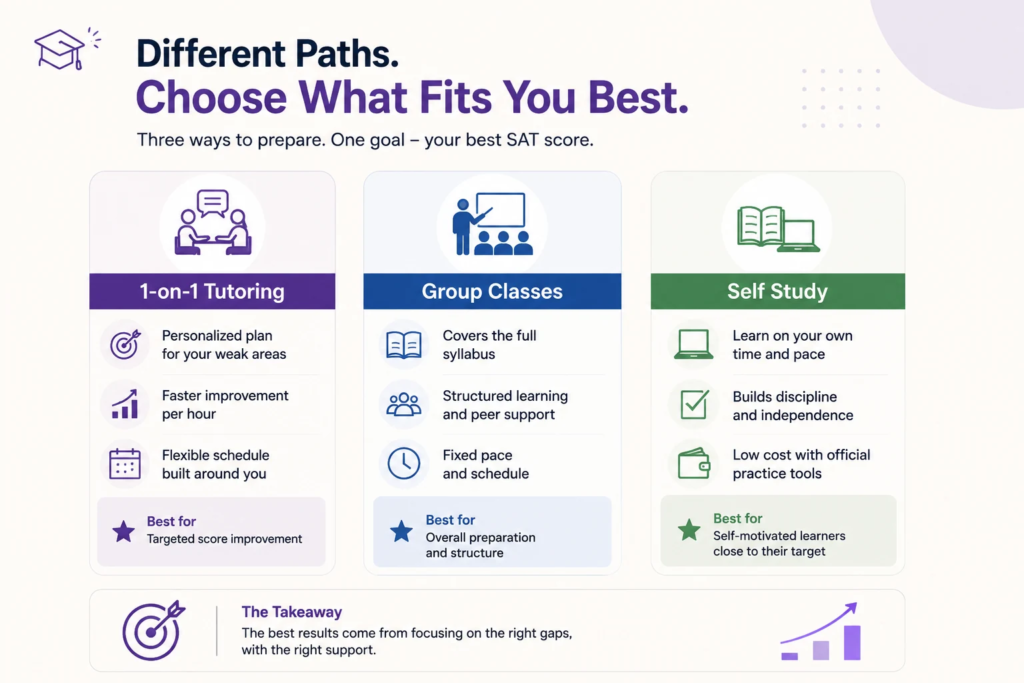
Good SAT tutoring for UAE students should start by diagnosing the gap, not by assuming every student needs the same syllabus walked through in order. A group class covers the full syllabus at a fixed pace regardless of what any individual student already knows. That is efficient for content coverage and genuinely useful for students who need structure more than customization. It is also the reason a strong reader can end up spending three sessions relearning grammar rules they already know, simply because the class schedule says so.
Self study, particularly through College Board’s own free Official SAT Practice, works well for students who are disciplined about identifying their own weak areas and following through independently. The research here is genuinely encouraging: College Board’s own analysis of roughly 250,000 students found that even six to eight hours of focused, personalized practice was associated with a 90 point average score gain. The catch is the word personalized. Random practice without a diagnostic plan behind it produces far weaker results.
1-on-1 tutoring sits between the two, and for many students in the UAE, families researching SAT tutoring in Dubai are specifically trying to solve the problem group classes cannot, a Math score stuck twenty points below target because of two or three recurring error patterns a generic class will never isolate. A tutor who runs a real diagnostic first, then builds sessions around the two or three highest impact gaps, tends to produce faster gains per hour than either alternative, simply because none of the time is spent on material the student has already mastered.
How Much Score Improvement to Actually Expect
Realistic numbers matter more here than optimistic ones. Students who work consistently with a 1-on-1 tutor for roughly fifteen or more hours, and who complete the practice assigned between sessions, commonly see gains in the range of 100 to 200 points on the Digital SAT. Students who attend sessions but skip the independent practice in between typically see far smaller gains, often closer to 30 to 50 points, which is not meaningfully different from what disciplined self study alone can produce. The tutoring itself is not what moves the score. The combination of expert diagnosis and consistent practice between sessions is what moves it, which is exactly the mechanism Bloom identified in 1984.
This is also where families researching SAT math prep UAE tend to see the clearest results, since Math is the section where a tutor can most easily isolate a specific gap, a misunderstood formula, a recurring algebra error, a pattern of running out of time on data analysis questions, and fix it directly rather than reviewing the entire syllabus.
When 1-on-1 Tutoring Is Worth It, and When It Is Not
It is generally worth the investment when a student has a specific score target tied to a real deadline, a recurring weak area that has not moved despite independent effort, or limited time before test day that makes efficiency more valuable than affordability. It is often not worth the premium when a student is already within striking distance of their target score, is a strong independent learner, or simply has not yet put in enough structured practice hours to know where the real gaps are, in which case a diagnostic test and a few weeks of focused self study might answer that question for free before any money changes hands.
Building a Tutoring Timeline Around Your Test Date
Tutoring works best when it is planned backward from an actual sitting rather than started reactively a few weeks before. Families mapping this out alongside the SAT exam dates UAE 2026 schedule generally get the strongest results by starting six to eight weeks of focused 1-on-1 work before their target date, with a diagnostic test in the first session and a full length practice test roughly every two weeks after that to track whether the gains are actually showing up under timed conditions.
Common Mistakes UAE Parents Make When Hiring a Tutor
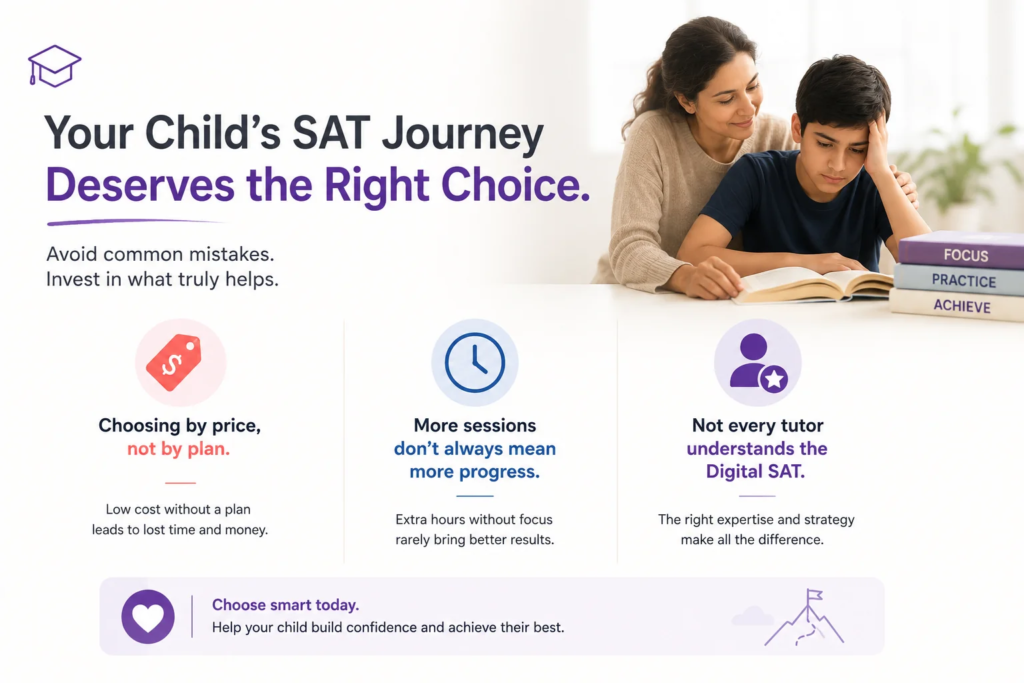
Choosing private SAT tutoring UAE families can trust starts with looking past the hourly rate. The most frequent mistake is hiring a SAT private tutor UAE parents found through a quick search, based on price alone, without asking for a diagnosis first. A cheaper tutor who spends the first three sessions figuring out where the student actually struggles is, in practice, more expensive than a specialist who starts with a clear plan. Families focused purely on SAT score improvement UAE searches often skip this step entirely and end up paying for trial and error instead of a targeted plan.
The second is assuming more sessions automatically means more improvement. Beyond a certain point, additional hours without new diagnostic data simply repeat what the student already knows. The third is choosing a generalist subject tutor instead of someone who specifically understands the Digital SAT’s adaptive module structure, since strategy for an adaptive test differs meaningfully from strategy for the old paper format.
What This Means Outside Dubai and Abu Dhabi
The same principles apply across the wider GCC, though the logistics shift. Families researching SAT Prep in Saudi Arabia often deal with fewer in person tutoring options and more reliance on online 1-on-1 formats, which makes the diagnostic first, targeted practice approach even more important, since there is less room to correct courses through in person trial and error.
Start With a Diagnostic, Not a Decision
A tutor is only as good as the diagnostic behind their plan, and that is where most generic tutoring falls short. SATisfactory builds every 1-on-1 program around a real diagnostic first, then targets the two or three gaps actually holding a student’s score back, rather than reviewing material they have already mastered. Book a free 30 minute demo to see exactly where your child’s score stands today and whether 1-on-1 tutoring, a group format, or a structured self study plan makes the most sense before you spend anything.