What Do People Actually Mean by “SAT Past Papers” in 2026?
Before 2023, “SAT past papers” had a clear meaning. The College Board ran a service called the Question-and-Answer Service, or QAS, that let students who took certain SAT dates order a copy of their actual test booklet, their answers, and the correct answers. Students and tutors built entire study plans around collecting these releases year after year.
That service is gone. It was discontinued in 2024 as part of the shift to the Digital SAT, and the College Board has confirmed it has no plans to bring it back. There is no equivalent today where you can order your exact test paper after sitting the digital exam.
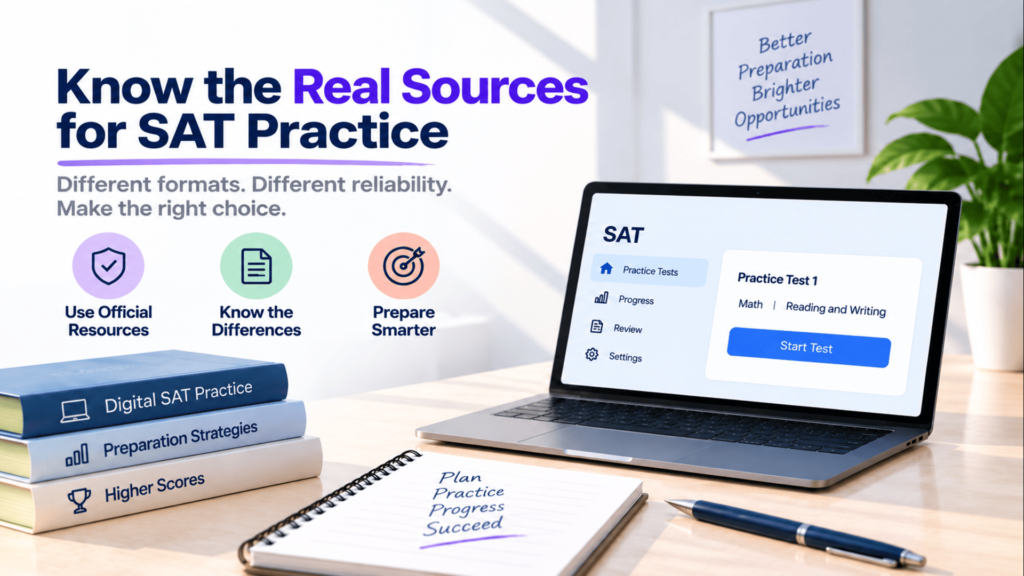
What you will find online under “SAT past papers” now falls into three very different buckets: official Bluebook practice tests released by the College Board, older paper-format SAT tests from before the digital transition, and unofficial reconstructions assembled by tutors and prep companies from memory or leaked question banks. Only the first two are reliable, and they serve different purposes, which is the distinction most students miss.
It is worth being specific about why the third bucket is risky. Unofficial “reconstructed” tests are built from students’ recollections after taking a real exam, or compiled from question banks of uncertain origin, and neither the difficulty calibration nor the answer explanations have gone through the same review the College Board applies to its own material. A student who scores well on a stack of these unverified sets can still be caught off guard on the real exam, simply because the practice never matched the actual difficulty curve in the first place.
Are Pre-2023 SAT Past Papers Still Useful for the Digital SAT?
Partly, and it depends on which section you are practicing. The underlying content, meaning the grammar rules, the algebra concepts, the reading comprehension skills, has not changed much between the paper SAT and the Digital SAT. A well-built sentence-correction question from 2019 still tests a real skill you need today.
What has changed is everything around that content. The Digital SAT runs on adaptive modules, meaning your performance on the first half of a section determines whether the second half gets harder or easier. A 2019 paper test has no concept of this, so it cannot train your pacing or your sense of how the test is calibrating around you.
The reading passages are also shorter now, generally one passage paired with one question instead of a long passage carrying six or seven questions. The math section allows a built-in graphing calculator for the entire section, which changes how some paper-era questions should even be approached. Older SAT past papers are still worth using for raw content practice, particularly grammar and vocabulary in context, but they should never be your only source, and they should not be timed as if they were the real thing.
A simple filter helps here: if a pre-2023 section came with a “no calculator” instruction, treat those specific questions as content practice only, not timed practice, since the Digital SAT removes that restriction entirely for math. Reading and Writing content holds up better since grammar rules and vocabulary in context haven’t changed, but even there, a passage built around six or seven attached questions no longer matches the one-passage, one-question format you’ll actually see on test day.
Not Sure Which of Your Old Papers Are Still Worth Doing?
Sorting a stack of pre-2023 material into what still applies and what’s wasting your time is exactly the kind of thing a second pair of eyes speeds up.
Where Can You Find Official SAT Practice Tests and Sample Papers?
The only fully official source is the Bluebook app, the same software the College Board uses to administer the real Digital SAT. As of 2026, Bluebook contains eight full-length official practice tests, numbered Test 4 through Test 11, and they are not all equally useful.
| Practice Test | Released | How to Use It |
|---|---|---|
| Test 11 | February 2026 | Highest priority. Closest match to current exam difficulty |
| Test 7 | February 2025 | Second priority. Fully new content, no recycled questions |
| Tests 8, 9, 10 | February 2025 | Good for volume practice, mixes older and newer question styles |
| Tests 5 and 6 | March 2024 | Still relevant, but slightly easier than the current calibration |
| Test 4 | Pre-2024 | Use for Reading and Writing only. The math content is outdated |
Beyond Bluebook, the College Board also publishes downloadable questions and answer explanations for these same eight tests on its official site, which is useful if you want a printable SAT sample paper to review away from a screen. Anything claiming to be an official SAT question paper from outside these two sources should be treated with caution, since it cannot be verified against real College Board material.
What Is the Difference Between SAT Past Papers, Sample Papers, and Practice Tests?
These three terms get used interchangeably, but they mean different things, and mixing them up is how students end up practicing with the wrong material at the wrong time.
| Term | What It Actually Is | Best Use |
|---|---|---|
| SAT past papers | Older, paper-format exams from before the digital transition | Extra content drills, not full timed simulations |
| SAT sample papers | Short excerpts or single-section previews, often from test-prep sites | Getting a feel for question style before starting real practice |
| Official practice tests | Full-length Bluebook simulations, adaptive, scored like the real exam | Timed, full-length rehearsal close to your actual test date |
A sample paper is a preview. A past paper has historical content. Only an official practice test actually rehearses the real exam experience, adaptive difficulty and all, and that distinction should drive how you build a study plan rather than just grabbing whatever appears first in a search result.
How Should You Use SAT Past Papers to Actually Prepare for the Exam?
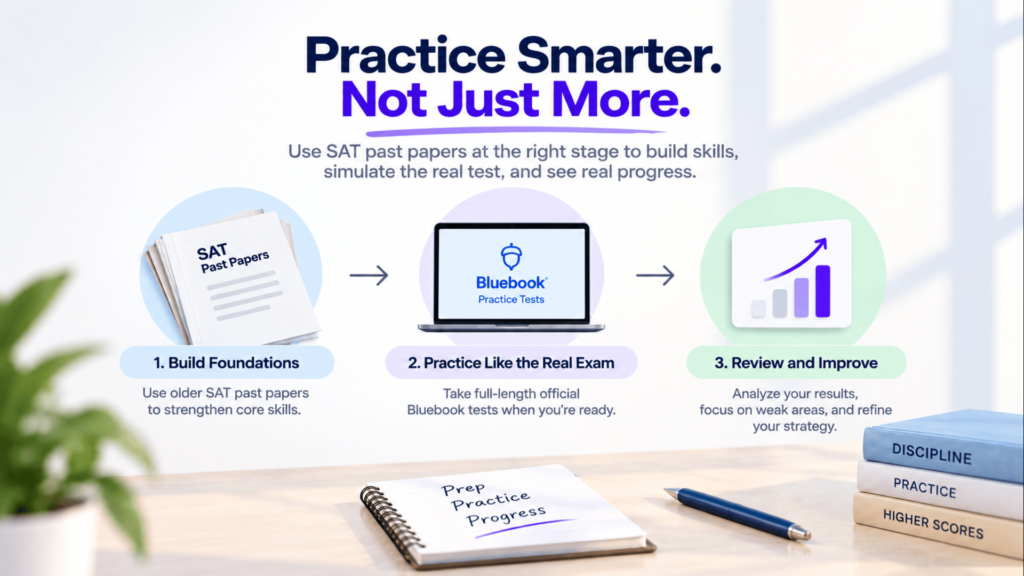
The biggest mistake students make with past papers is treating them as a pile to get through rather than a tool with a sequence. Content-only material, like older SAT past papers, works best early in your prep, when you are still building foundational skills in grammar, vocabulary in context, and core algebra.
Full-length official Bluebook tests belong later in the timeline, ideally once you have covered most of the content and are ready to rehearse the actual test experience under real conditions. Take them at the same time of day as your real exam, in a quiet room, with the same breaks the real test allows, so your brain gets used to sustaining focus for the full session.
Do not mix formats within a single practice session. Reviewing an old paper-format grammar drill and then jumping into a timed Bluebook math module in the same sitting blurs the signal you are trying to get from each one. Separate them, and treat every full-length official test as a dress rehearsal rather than just another worksheet.
How Often Should You Take a Full SAT Practice Test?
There is no single number that fits every student, but a rough cadence works well for most GCC-based students balancing SAT prep alongside a full school timetable.
| Stage | Recommended Frequency | Purpose |
|---|---|---|
| Diagnostic (start of prep) | One full test | Establish a baseline score and identify weak areas |
| Active prep (months 2 to 4) | One full test every 3 to 4 weeks | Track progress without burning through official material too fast |
| Final stretch (4 to 6 weeks out) | One full test every 1 to 2 weeks | Build stamina and finalize pacing strategy |
| Week of the real exam | None, or one light review session | Avoid fatigue and test anxiety going into the real date |
Taking a full practice test more often than this usually backfires, since you will run out of official Bluebook material and start relying on lower-quality unofficial tests that do not calibrate the same way. Quality of review matters more than raw frequency of testing.
How Should You Review Your Mistakes After Completing an SAT Practice Test?
This is the step most students skip, and it is the one that actually moves a score. Without the old Question-and-Answer Service, there is no automatic breakdown of exactly which question you missed and why, so that review has to be done manually or with a tutor who can reconstruct it from your Bluebook results.
Start by sorting every wrong answer into one of three categories: a content gap, meaning you genuinely did not know the underlying rule or concept; a careless error, meaning you knew the material but rushed or misread the question; or a timing error, meaning you ran out of time before reaching the question at all. These three categories need completely different fixes.
Content gaps need targeted review of that specific topic, not another full practice test. Careless errors usually shrink once you build a habit of rereading the question stem before choosing an answer. Timing errors mean you need to practice pacing on individual modules rather than assuming another full test will fix the problem on its own.
Keep a running error log across every practice test rather than reviewing each one in isolation. Patterns that seem random after one test often become obvious after three or four, and that pattern is usually where the next real jump in score comes from.
A practical rule of thumb: budget at least as much time for review as you spent taking the test itself. A rushed twenty-minute skim of your results after a two-hour practice test almost never surfaces the real pattern behind a missed question, while a slower, section-by-section walk-through usually does. Students who treat review as optional tend to plateau after two or three practice tests, even when they keep adding more tests to the pile.
Are SAT Subject Tests Still Available?
No. The College Board discontinued SAT Subject Tests in 2021, and they are no longer offered to students in the United States or internationally. If you come across older college-admissions pages or SAT preparation resources that still mention Subject Tests, check the publication date before relying on that information, as it may refer to an outdated version of the SAT.
There is no current SAT Subject Test to register for or prepare for, so students preparing for the SAT in 2026 should not spend time practicing for them. Instead, preparation should focus on the current Digital SAT and official practice materials that reflect the format, question types, and testing experience students will encounter today.
How Can Older SAT Questions Help With Math Practice?
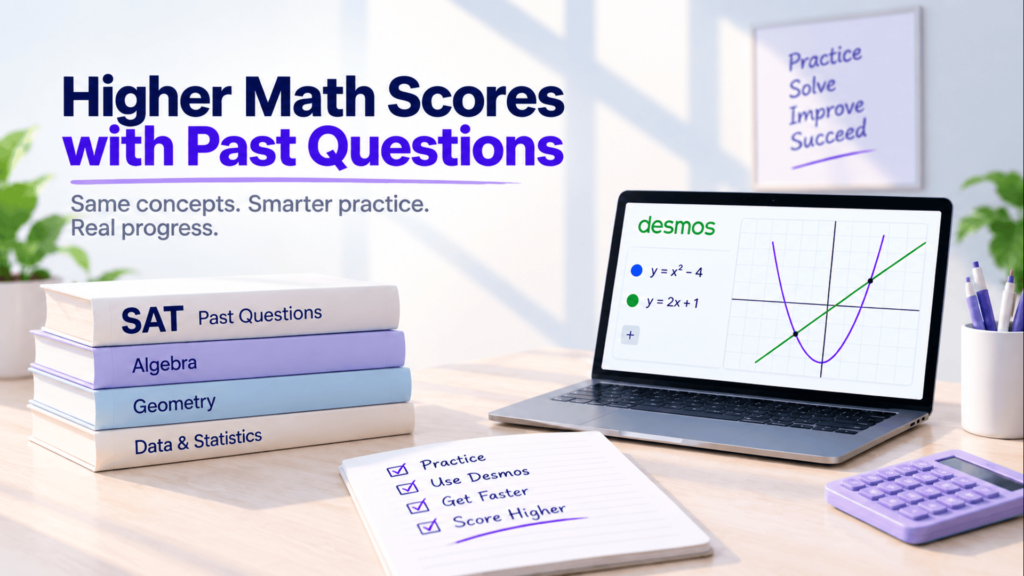
Older SAT questions can still be useful for strengthening math concepts that remain relevant to the Digital SAT. Topics such as linear equations, ratios, basic statistics, and geometry continue to appear, making older questions useful for targeted practice when you need more questions on a specific topic.
The key is to use older questions for content practice, not as a full Digital SAT simulation. They were created for a different test format and calculator experience, while the Digital SAT provides a built-in Desmos graphing calculator throughout the Math section. This makes older questions more useful for reinforcing concepts than for recreating the current test experience.
For structured SAT Math Practice, focus on one topic at a time, work through relevant older questions, and review any mistakes you make. Then, use a timed Bluebook Math module to check whether you can apply the same skill under current Digital SAT conditions.
Why Does Using Past Papers the Right Way Matter Even More Right Now?
Standardized testing is no longer optional at the schools many GCC families are aiming for. As of the 2026 to 2027 application cycle, six of the eight Ivy League universities already require an SAT or ACT score, and Columbia announced in June 2026 that it will join them starting with the 2027 to 2028 cycle, closing the last remaining test-optional door among the Ivy League. For a student currently in grade 10 or 11, there is effectively no scenario left where a strong SAT score is optional at the most selective US universities.
This sits alongside a requirement most GCC families already know about from the school side: the UAE Ministry of Education’s equivalency process for an accredited high school diploma currently requires a minimum SAT Math score alongside English proficiency scores, regardless of which school a student attended. A student can have an excellent GPA and still hit a wall in that process without a qualifying score, which makes disciplined, well-sequenced practice with the right material a practical necessity rather than an academic extra.
SAT Exam in UAE registration runs through the College Board’s own international test center network, with Dubai, Abu Dhabi, and several other emirates hosting regular Digital SAT dates throughout the school year, so logistics are rarely the bottleneck. The bottleneck is almost always preparation quality, specifically whether a student has been practicing with current, correctly sequenced material rather than outdated paper-format tests treated as if they were the real thing.
Families comparing SAT coaching centres in Dubai will find no shortage of tutoring options, but the schools with the strongest outcomes tend to combine a diagnostic-first approach with the same official Bluebook material discussed above, rather than building a study plan entirely around third-party question banks of uncertain origin.
The picture looks similar just across the Gulf. Families exploring sat preparation in saudi arabia face the same core exam, the same eight official practice tests, and the same testing-requirement pressure from US universities, even though school systems, calendars, and local test center availability differ from the UAE.
How SATisfactory Fits Into This
SATisfactory works with students across the UAE, Saudi Arabia, and the wider GCC on exactly this problem: turning official Digital SAT material into a study plan that actually fits a student’s school calendar, current level, and target score, rather than handing over a folder of past papers and hoping for the best.
From there, the most useful next step is usually a real diagnostic rather than another worksheet, so when you are ready, Start a Mock Test built on official Bluebook-format questions to see a full, section-level breakdown of where your score actually stands today.
SATisfactory is a UAE-based SAT prep platform rated 4.9 by students and parents across the GCC. Students across Dubai, Abu Dhabi, and the wider Middle East use SATisfactory’s SmartMock system and expert tutoring to reach their target scores for universities in the US, UK, and Canada.