
Sharjah sits close enough to Dubai that many families end up comparing notes with parents researching SAT Prep in Dubai, and the two markets do share overlapping international school networks and tutoring resources. But Sharjah has its own academic mix: a large number of CBSE and ICSE schools sit alongside IB, British curriculum, and American curriculum schools, often within the same neighbourhood. That mix matters more for SAT preparation than it does for most other exams, because a student’s curriculum background changes where their actual score gap sits.
Why Your Child’s Curriculum Shapes Their SAT Prep in Sharjah

A CBSE or ICSE student in Sharjah typically arrives with strong, structured math training. Where they usually lose the most ground is the Reading and Writing section, which rewards evidence-based reasoning and rhetorical analysis in a style most Indian-curriculum school assessments don’t practise directly.
An IB student often brings strong analytical and argumentative writing from Theory of Knowledge and the Extended Essay. But the SAT’s tightly timed, multiple-choice format tests a narrower, faster kind of reasoning than IB assessment does, and that shift takes deliberate practice to get used to.
A British curriculum (A Level) student usually has deep subject expertise and strong essay technique. The friction point is pacing and question logic. A Level papers reward depth on fewer questions; the SAT rewards speed and precision across many short, high-weight questions.
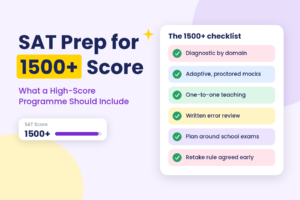
None of these students are behind. Each of them needs a different first two weeks of prep. That’s why we don’t start a plan from a curriculum assumption. We start from a full-length diagnostic mock test taken inside Bluebook, under real timed and adaptive conditions. Start a Mock Test and let the result tell us exactly where the gap sits, section by section and module by module.
How the Digital SAT Works, and Why It Changes the Way You Should Prepare
If the last time you looked into the SAT was more than a year or two ago, what you read is probably describing a different test. The College Board moved the SAT fully digital in 2024, and that shift changes what “good preparation” actually means, not just where the test is taken.
The current SAT is delivered through the College Board’s Bluebook application, and its defining feature is an adaptive module structure. Reading and Writing, and Math, are each split into two modules. The questions in Module 2 aren’t fixed. They’re assigned based on how the student performs in Module 1: a strong Module 1 unlocks a harder Module 2 with a higher score ceiling, while a weaker Module 1 caps the maximum score the student can reach in that section, regardless of how well they answer afterward.
This is why practising on the actual Bluebook platform matters more than working through PDFs or generic prep apps that don’t replicate the adaptive experience. A student who has only practised on static materials is, in a real sense, practising for a test that no longer exists.
Reading and Writing presents short passages paired with one or two high-weight questions each, testing comprehension, vocabulary in context, rhetorical purpose, and grammar and usage. Math covers algebra, advanced math, problem-solving and data analysis, and geometry and trigonometry, with a calculator (including a built-in Desmos tool) allowed throughout. Sharjah students from CBSE and ICSE backgrounds often find Math the more accessible section, but reaching the top of it still requires targeted practice with the word-problem style data analysis questions, since these test English-language interpretation as much as calculation. If Math is the section your child needs the most work on, our SAT Math Preparation Guide breaks down each topic area and where students typically lose points.
Score targets vary by university tier, and it helps to plan against a real number rather than a vague goal:
| Target | Typical range |
|---|---|
| Most selective US universities | 1500 and above |
| Strong second-tier institutions | 1380 to 1480 |
| Universities where the SAT is one factor among several | 1300 and above |
Check the specific middle-50 percent SAT range published by each university on your child’s list. These bands are a planning starting point, not a guarantee.
Structuring a SAT Preparation Course Sharjah Students Can Actually Follow
Every plan starts with the diagnostic, and everything after it is built around that student’s actual result rather than a generic syllabus. In practice, a full preparation window looks like this:
| Weeks before test date | Focus area | What happens |
|---|---|---|
| 16 to 20 | Diagnostic and foundations | Full-length Bluebook diagnostic; weak topics identified across Reading, Writing, and Math |
| 10 to 15 | Skill building | Topic-by-topic practice, targeted drills, concept review |
| 5 to 9 | Timed practice | Section-level timed sets, deeper Bluebook familiarisation |
| 1 to 4 | Full simulations | Full-length adaptive mock tests, review, light revision only in the final week |
SmartMocks, run roughly every two weeks through the skill-building and timed-practice phases, give students additional full-length, adaptive Bluebook SAT practice that mirrors the real test experience, so progress is tracked on the same format the student will actually sit. PlanPilot then adjusts the weekly schedule automatically as school demands shift, so a student in the middle of IB internal assessments or CBSE board prep gets a different week than one with a lighter term.
Sharjah students juggling coursework, board exams, or IA deadlines alongside SAT prep need a schedule that bends without breaking. That’s the entire design goal behind FlexiTutor: sessions move around school commitments without the plan losing its structure.
SAT Tutoring Sharjah: Choosing 1:1, Group Classes, or a Combined Plan

Once the diagnostic shows where the gap actually sits, the next decision is format, and it matters more than most families expect.
| If your child… | Best-fit format |
|---|---|
| Has an unpredictable school schedule (IAs, board exams, sports) | 1:1 SAT tutoring in Sharjah with FlexiTutor scheduling |
| Is early, in Year 10 or 11, with time to build steadily | Small group SAT classes |
| Has one or two specific weak sections after a diagnostic | Hybrid: group instruction plus targeted 1:1 sessions |
| Is retaking the SAT to close a known gap | 1:1, focused specifically on the last score report |
One-to-one tutoring gives the most precision. A good SAT tutor Sharjah families trust will direct every session at what the mock data shows is actually costing marks, and scheduling can move around school events without disrupting the plan. Small group SAT classes Sharjah students join work well for those who want a clear programme structure and the accountability of preparing alongside peers with similar goals, at a more accessible price point than 1:1. Many Sharjah families land on a hybrid: group sessions for core content and strategy, with 1:1 sessions layered in wherever the mock analysis keeps flagging the same weak area.
If your child needs SAT with accommodation support, such as extended time, a separate room, or text-to-speech, it should be built into every practice session from the first mock test onward. Accommodations only deliver their full benefit when they’ve been rehearsed consistently, not encountered for the first time on test day.
SAT Tutoring Cost Sharjah: What Actually Drives the Price
SAT tutoring cost in Sharjah depends less on the “brand” of the course and more on three concrete factors: format, length of the plan, and how much of it is individually tailored. One-to-one tutoring costs more per hour than group classes because it includes a dedicated tutor, an individual plan, and flexible scheduling. A full 16 to 20 week programme naturally costs more in total than a short, targeted retake track built around a specific score report.
That last point matters for a lot of Sharjah families: if your child has already taken or given the sat, what they usually need is a score booster, a focused plan built from their actual gap, not a repeat of the full plan from week one.
The more useful question isn’t “what does this cost” in isolation. It’s what a realistic SAT score improvement actually changes. A jump from 1300 to 1450, around 150 points, is often the difference between a solid state flagship and serious contention at several highly ranked private universities, along with the scholarship tiers that come with each. That’s a conversation worth having with real numbers for your child’s situation.
If you want an exact quote for your child’s format and timeline, book a free demo session and we’ll walk you through it.
Matching Your SAT Prep Timeline to Application Deadlines
The College Board typically offers the SAT in August, October, November, December, March, May, and June. In the UAE, October and December seats fill up well ahead of the registration deadline, so timing your prep around registration, not just the test date, matters.
As a general guide:
- Early Decision and Early Action applicants (usually November deadlines) need scores in by mid-October, which means sitting the test in August at the latest, and starting prep by April or May for a full runway.
- Regular Decision applicants (usually January deadlines) can sit the test in October, November, or December, but a December sitting still needs prep to start by August or September to avoid a rushed final stretch.
- Year 10 and early Year 11 students have the most flexibility: multiple sittings available, and no need to compete for time with a final application year.
For the full 2026 to 2027 College Board schedule and how it lines up with the UAE school calendar, see our SAT Exam Dates UAE guide.
What to Check Before Choosing SAT Prep in Sharjah
A few questions are worth asking any programme, including ours, before committing:
- Does it start with a full-length, timed, adaptive Bluebook diagnostic, or with generic course content?
- Is practice actually done inside Bluebook, or on static PDFs and apps that don’t replicate the adaptive experience?
- Does the schedule visibly adjust when your child’s school term gets heavy, or is it fixed regardless of clashes?
- Can you see real, verifiable outcomes, not just marketing language?
Real Results From SATisfactory Students
A SATisfactory student at Brighton College Al Ain reached a perfect 1600, the highest recorded Digital SAT result in the Middle East since 2023. Akansha Singhania, at Dubai International Academy, scored 1570. Athul A. Sandeep, at Faips DPS Kuwait, also reached 1570. None of these students started from a 1500-plus baseline. Each followed a structured, multi-month plan built the way this guide describes: diagnostic first, timed Bluebook practice throughout, and consistent review of every mistake. You can read more of these in our SAT Success Stories.
The same diagnostic-first approach powers SAT Coaching in Saudi Arabia and our other GCC programmes, so the process doesn’t change based on which city a family is preparing from. SATisfactory has been featured in Khaleej Times and is rated 4.9 by students and parents across the GCC.
Get Started With a Free SAT Diagnostic
The clearest way to know where your child actually stands is a real diagnostic, not a guess based on school grades. A free SmartMock gives a full section-level score breakdown in under two hours, on the same adaptive format as the real test. If you’d rather talk it through first, contact us and we’ll help you figure out the right starting point, format, and timeline for your child’s situation.