
Why SAT Math Feels Different From School Math
Most UAE students walk into their first SAT Math practice test expecting something close to their IGCSE, IB, or A Level exams. That expectation usually breaks down fast, and it is worth naming why, rather than letting a student quietly assume they are simply not good at math.
The SAT Math section is not testing how much content a student has memorized. It is testing how quickly and accurately a student can apply core concepts under time pressure, inside a format that adapts based on how the first module goes. A student can know every formula in a chapter and still underperform if they have never practiced recognizing which formula a question is asking for within ninety seconds.
This is worth acknowledging, because a student who is genuinely strong at math can freeze on a familiar looking question under a timer and walk away feeling like the test has proven something false about their ability. It has not. It has only shown that timed, adaptive test taking is its own skill, separate from classroom performance, and one that can be built with the right practice.
What Is Actually on the SAT Math Section
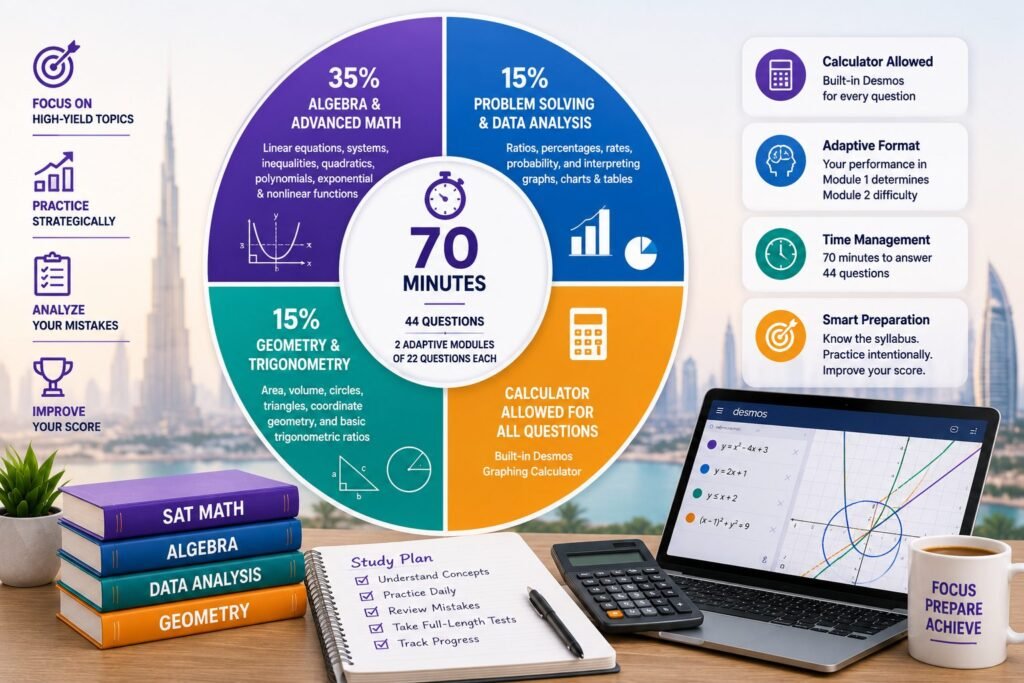
Understanding the SAT Math syllabus removes a lot of the anxiety that comes from not knowing what to expect. The section covers four content domains, shown below.
| Domain | Approximate Weight | What It Covers |
| Algebra and Advanced Math | About 70 percent combined | Linear equations, systems, inequalities, quadratics, polynomials, exponential and nonlinear functions |
| Problem Solving and Data Analysis | About 15 percent | Ratios, percentages, rates, probability, and interpreting graphs, charts, and tables |
| Geometry and Trigonometry | About 15 percent | Area, volume, circles, triangles, coordinate geometry, and basic trigonometric ratios |
All four domains appear in both modules, so there is no topic a student can skip. A calculator, including the built in Desmos Graphing Calculator, is available for all 44 questions, a meaningful shift from the older paper based SAT and its separate no calculator half.
The Desmos Graphing Calculator Advantage
One of the most underused resources in SAT math prep for UAE students is the Desmos Graphing Calculator itself. Because it sits directly inside the Bluebook testing app, students can graph functions, check algebra by substitution, and visually confirm an answer in seconds rather than solving everything by hand under pressure.
The mistake many students make is treating Desmos as something to figure out on test day. Students who spend real time beforehand learning to graph inequalities, find intersections, and sanity check word problems consistently finish modules with more time left for questions that genuinely need careful thought. This is worth practicing early, not on the night before.
A Realistic SAT Math Study Guide for UAE Students
A study plan only works if it survives contact with a real school term, and UAE students are usually balancing SAT prep alongside IGCSE, IB, or A Level coursework. The table below outlines a realistic ten week structure that fits around most school calendars.

| Week Range | Focus |
| Weeks 1 to 2 | Full diagnostic test, baseline score, and identifying weak domains |
| Weeks 3 to 6 | Topic wise practice in Algebra and Advanced Math, since these carry the most weight |
| Weeks 7 to 8 | Problem Solving and Data Analysis, plus Geometry and Trigonometry |
| Weeks 9 to 10 | Full length timed practice tests and error log review before the test date |
Two to three focused sessions of sixty to ninety minutes a week is usually enough, provided every wrong answer gets reviewed properly instead of simply marked and moved past.
SAT Algebra Tips for UAE Students
Since Algebra and Advanced Math make up roughly seventy percent of the section, this is the single highest leverage area for score improvement, and a few habits make a real difference for SAT algebra UAE students specifically:
- Practice isolating variables and solving systems of equations until it feels automatic.
- Learn to spot word problems that are actually linear equations in disguise.
- Revisit quadratic equations using more than one method, including factoring and the quadratic formula.
- Use Desmos to graph a function whenever a question feels ambiguous. The shape of an equation often reveals the answer faster than solving it by hand.
SAT Math Practice Questions: Practicing the Right Way
Working through SAT math practice questions only builds a score when the practice includes real review. After every set, a student should be able to explain why the correct answer is correct and, just as importantly, why their own answer was wrong. This is what separates students who plateau from students who keep improving.
For UAE students who have not yet taken a diagnostic, free SAT practice tests UAE families can access through the official Bluebook app are the most reliable starting point, since they mirror the real adaptive format. Sitting one early, before choosing a target score or test date, gives a far more honest picture of where preparation needs to focus.
Common Mistakes UAE Students Make in SAT Math
Most students do not lose marks because they never learned the topic. They lose marks in ways that are far more fixable once named clearly.
- Rushing early questions because they feel easy, then making a careless error that costs the same as missing a harder one later.
- Avoiding Desmos out of habit, even when it would save real time.
- Guessing without a method rather than eliminating clearly wrong choices first.
- Moving on from a wrong answer without understanding the actual reason it was wrong.
If you are wondering how to improve SAT score UAE outcomes in a way that holds up on test day, closing these specific habits usually produces faster gains than adding more raw practice hours. Score improvement is rarely about knowing more. It is about making fewer of the same avoidable mistakes each time you sit down to practice.
Where to Get Structured SAT Math Support
Self study works well for students already comfortable with pacing and error review. Many UAE students benefit from a structured plan built around their own school calendar and weak areas instead.

Families searching for SAT prep in Dubai will find that most reputable programs combine a diagnostic first approach with weekly timed practice and genuine review, rather than simply assigning more question sets. The same fundamentals matter regardless of city, so families exploring SAT prep in Saudi Arabia should look for the same things: a real starting diagnostic, a plan built around the student’s own school term, and tutors who review mistakes with the student rather than only grading them.
SAT Exam Dates UAE 2026
Knowing the SAT exam dates UAE 2026 schedule helps students work backward from a realistic preparation window rather than choosing a date first and hoping the plan fits. The fall 2026 sittings fall on August 22, September 12, October 3, November 7, and December 5, with spring 2027 dates set for March 6, May 1, and June 5. Grade 11 students usually get the most value from an August or September sitting, since it leaves room for a retake before Grade 12 deadlines, while Grade 12 students who have not yet registered should look closely at October or November.
Find Out Where Your SAT Math Score Actually Stands
If you are unsure how much SAT math prep you actually need, the most useful next step is a diagnostic, not a guess. A free SmartMock mirrors the real Bluebook experience and gives a section level breakdown in under two hours, so you know which topics deserve your time before committing to a plan or a test date.
If you would rather talk through your child’s grade, school calendar, and target universities first, book a free 30 minute demo with a SATisfactory tutor. There is no pressure involved, just a clear, honest plan built around where your child is right now.
SATisfactory is a UAE based SAT prep platform rated 4.9 by students and parents across the GCC. Students across Dubai, Abu Dhabi, and the wider Middle East use SATisfactory’s SmartMock system and expert tutoring to reach their target scores for universities in the US, UK, and Canada.