
Before filtering anything, it helps to know your actual starting point. Start a Mock Test that mirrors the real Bluebook experience first, then use everything below to turn those results into a targeted practice plan.
What Exactly Is the SAT Question Bank?
The Student Question Bank is College Board’s official library of real, previously used SAT and PSAT questions, the same ones written by the people who build the actual test, not third-party guesses at what the format looks like. You reach it through My Practice at mypractice.collegeboard.org, signing in with either a personal College Board account or a school-issued sign-in ticket from a PSAT or SAT School Day sitting.
That access detail matters more than it sounds. A personal account gives permanent access, but a school ticket expires after 90 days, so a UAE student who only has a ticket from a school PSAT sitting needs to either create a personal account or use that window before it closes.
The Question Bank is not the same thing as a full Bluebook practice test, and mixing the two up wastes study time.
| Student Question Bank | Full Bluebook Practice Test | |
|---|---|---|
| Timing | Untimed, question by question | Timed, mirrors real test conditions |
| Purpose | Targeted drilling on weak domains | Full simulation, including adaptive modules |
| Length | You choose, from a handful to dozens | Fixed at 98 questions across both sections |
| Best used | Between mocks, to fix specific gaps | Every few weeks, to track overall readiness |
What Can You Actually Filter By, and Why Does It Matter?
Inside the Question Bank, you can filter by assessment (SAT or PSAT), test (Reading and Writing or Math), domain, specific skill within that domain, and difficulty level. That’s five layers of precision most students never touch, defaulting instead to whatever questions load first.
The eight official content domains are the same ones the real exam is built from.
| Section | Domain | Weight on the Real Test |
|---|---|---|
| Reading and Writing | Craft and Structure | ~28% |
| Reading and Writing | Information and Ideas | ~26% |
| Reading and Writing | Standard English Conventions | ~26% |
| Reading and Writing | Expression of Ideas | ~20% |
| Math | Algebra | ~35% |
| Math | Advanced Math | ~35% |
| Math | Problem-Solving and Data Analysis | ~15% |
| Math | Geometry and Trigonometry | ~15% |
One independent analysis of the bank’s full question pool also found it skews noticeably harder than the real test’s actual difficulty mix, with roughly six Hard questions for every Easy one. If your score already sits above 1200, that works in your favor. If you’re closer to a 1000, filtering to Medium first, rather than whatever loads by default, keeps practice matched to where you actually are.
What Are the Actual Skills Behind Each Domain?
College Board’s own Question Bank page admits its domain names can be hard to decipher, and it’s right. Filtering to “Craft and Structure” or “Advanced Math” means nothing until you know what specific skills live inside each one.
| Domain | Skills Inside It |
|---|---|
| Information and Ideas | Central Ideas and Details, Command of Evidence (Textual), Command of Evidence (Quantitative), Inferences |
| Craft and Structure | Words in Context, Text Structure and Purpose, Cross-Text Connections |
| Standard English Conventions | Boundaries (punctuation between clauses), Form, Structure, and Sense (grammar and agreement) |
| Expression of Ideas | Rhetorical Synthesis, Transitions |
| Algebra | Linear equations and functions, linear inequalities, systems of two linear equations |
| Advanced Math | Equivalent expressions, nonlinear equations and systems, nonlinear functions |
| Problem-Solving and Data Analysis | Ratios and rates, percentages, one- and two-variable data, probability, statistical inference |
| Geometry and Trigonometry | Area and volume, lines and angles, right triangles and trigonometry, circles |
Once you know a mock test flagged Standard English Conventions as weak, for instance, you’re not guessing what to filter for. You go straight to Boundaries or Form, Structure, and Sense, whichever the score report points to, instead of drilling the whole domain broadly.
How Do You Know Which Domain to Drill First?
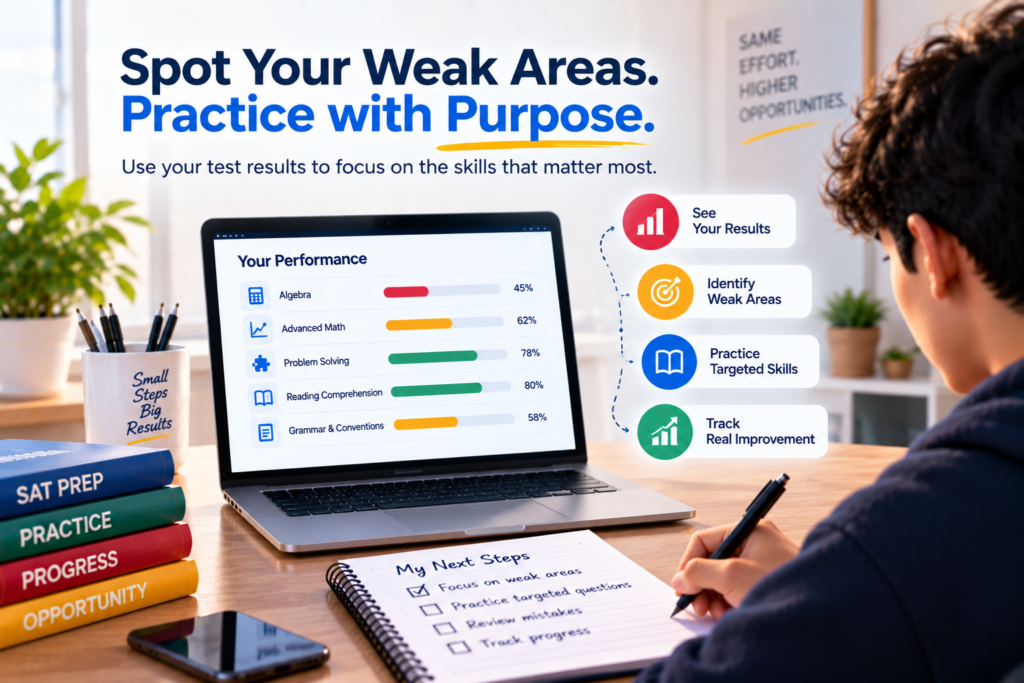
The College Board actually publishes an official method for this, and almost nobody uses it. Every score report or Bluebook practice score shows a progress bar for each domain, broken into five boxes.
If your domain score falls in the first three boxes, start with Easy questions in the Question Bank for that domain, then move to Medium once those feel manageable. If it falls in the fourth or fifth box, start at Medium, push into Hard, and still circle back to an occasional Easy question just to confirm you haven’t lost the fundamentals under pressure.
There’s also a shortcut called Tailored Practice. After any official test or Bluebook practice test, My Practice can auto-generate a question set pulled straight from the Question Bank based on exactly how you performed, so you don’t have to manually match your weak domain to the right filter yourself.
How Do You Actually Set Up a Practice Session, Step by Step?
Knowing the theory doesn’t help if the filters themselves feel unfamiliar. Here’s the actual sequence.
- Sign in to My Practice at mypractice.collegeboard.org with your College Board account or school sign-in ticket.
- Open your most recent score report first, if you have one, and note which domain shows the lowest progress bar.
- Go to the Question Bank tab and select your assessment (SAT) and test (Reading and Writing or Math).
- Select the domain your score report flagged, then narrow further to the specific skill if one stands out.
- Set the difficulty based on your progress bar, Easy or Medium for boxes one to three, Medium or Hard for boxes four and five.
- Generate the set and work through it with scratch paper beside you, the same way you would on test day.
- Open Score Details immediately after and read the explanation for every question you missed, not just the correct answer.
As an example, a student whose last mock showed Standard English Conventions sitting in the third progress box would filter to that domain, set difficulty to Easy, work through ten to fifteen questions, and only move to Medium once accuracy holds above roughly 80 percent.
What’s the Right Way to Practice With SAT Practice Questions From the Bank?
Untargeted repetition is the most common way UAE students waste hours on SAT practice questions without moving their score. The fix is a short, repeatable loop, not a bigger pile of questions.
Start with a real diagnostic, either an official practice test or your most recent score report, so you know which domain is actually weak instead of guessing. Pull a filtered set from that domain at the difficulty level your progress bar suggests, and work through it under the same conditions you’d face on test day. Review every wrong answer immediately using the Score Details page, not days later when you’ve forgotten your reasoning, since the explanation matters more than the correct letter.
Re-test that same domain in two to three weeks. If the accuracy hasn’t moved, the gap usually isn’t content, it’s a specific misunderstanding worth reviewing with a tutor rather than repeating the same questions again. A structured diagnostic like a full mock tells you far more in two hours than another week of scattered SAT prep questions ever will.
Are the SAT Sample Questions in the Bank the Same as the Real Test?
Yes, and that’s what actually separates the Question Bank from most of what shows up in a search for SAT sample questions. Every item in it is a real, previously administered question released by College Board, built to the same content standards and difficulty calibration as the exam you’ll actually sit.
A lot of the free SAT sample questions circulating on random websites are written by someone reverse-engineering the format from memory, with no guarantee they match current domain weightings or question phrasing. Relying on those instead of the official bank is one of the patterns covered in common sat mistakes, and it’s an easy one to avoid since the real thing is free and requires only a College Board account.
How Does the Question Bank Compare to Other SAT Study Materials?

The Question Bank is one piece of a bigger toolkit, and knowing what each piece is actually for stops UAE students from either over-relying on one resource or scattering their time across too many.
| Resource | Best For | Limitation |
|---|---|---|
| Student Question Bank | Targeted domain and skill drilling, untimed | No progress graph, no adaptive simulation |
| Full Bluebook practice test | Pacing, adaptive routing, realistic scoring | Only every few weeks, not for daily drilling |
| Khan Academy (linked from My Practice) | Video explanations tied to missed skills | Best paired with, not instead of, the Bank |
| Printed or third-party question sets | Bulk repetition, offline practice | Often unverified against current domains |
| Structured tutoring (like SATisfactory) | Spotting patterns a student can’t see alone | Costs more than free tools, but adds review |
The Question Bank is free and genuinely useful, but it has real limits worth knowing before you build a study plan entirely around it.
- No progress-over-time graph. It shows results per session, but improvement from 70 percent accuracy to 85 percent in a domain over six weeks isn’t something the tool tracks for you.
- No adaptive simulation. Every question sits on its own, untimed, so it can’t reproduce the real exam’s module-to-module difficulty shift.
- No built-in pacing pressure. Working through a filtered set at your own pace is useful for learning, but it won’t train the clock-watching instinct a timed mock does.
- No feedback on why a pattern keeps repeating. It shows you got a question wrong and explains that question, but spotting a recurring habit across ten wrong answers still takes a second set of eyes.
A pattern SATisfactory’s tutors see constantly: the Question Bank is the best free tool for fixing a weakness a student has already identified. It’s not built to identify that weakness in the first place, or to show how a student will actually perform under real adaptive time pressure. That gap is usually where a structured review session helps more than another filtered set of questions.
This same comparison holds well beyond the UAE. Families exploring SAT Preparation in Saudi Arabia are weighing the identical Question Bank against the identical mix of study materials, just building their schedule around a different set of school calendars.
A complete set of SAT study materials for a UAE student combines three things: the Question Bank for targeted domain drilling, full-length timed mocks (through Bluebook or a platform like SmartMock) for pacing and adaptive practice, and a review process that catches patterns a student can’t easily see in their own mistakes. Arjun’s result is real, but he’s also the exception. Most students need that domain-by-domain review built into a weekly plan rather than designed alone, which is exactly where SATisfactory, recognized by Khaleej Times for producing some of the highest Digital SAT scores in the region, fits in.
Is There a Faster Daily Alternative to the Full Question Bank?
Yes, and it’s easy to miss because the College Board doesn’t promote it heavily. Question of the Day delivers one official question at a time, lets you build a streak, earn badges, and see how your answer compares to other students who tried it, all through the same sign-in as Bluebook and My Practice.
It’s not a replacement for filtered domain drilling, but it fits a different moment in a study plan.
- Use Question of the Day for a quick daily habit, keeping a domain fresh between longer sessions, or easing a reluctant student into consistent practice.
- Use the full Question Bank for anything you’re actively trying to fix, since it lets you choose the domain, skill, and difficulty instead of taking whatever question comes up.
A student two months from test day gets more from ten minutes of filtered Question Bank practice on a known weak spot than from the daily question alone. A student six months out, still building the habit of practicing at all, often benefits from starting with the lighter daily version first.
How Should the Question Bank Fit Into a Weekly Study Schedule?
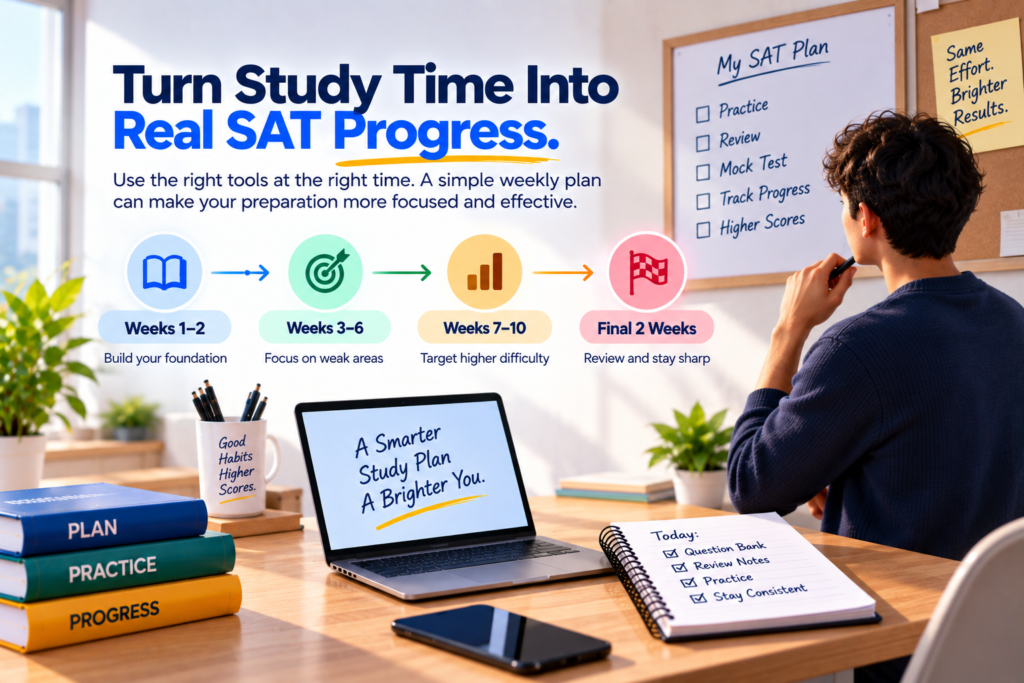
The Question Bank works best as the tool between mock tests, not instead of them. For a student with roughly two to three months before test day, a realistic week looks like short, filtered Question Bank sessions on most days, with a full mock every second or third week.
| Week Type | Question Bank Use | Full Mock |
|---|---|---|
| Weeks 1 to 2 | Filter to every domain once, establish a baseline per skill | One diagnostic mock |
| Weeks 3 to 6 | Daily 20 to 30 minute sessions on the two weakest domains | One mock every two weeks |
| Weeks 7 to 10 | Shift filters toward Hard as scores improve, revisit Easy occasionally | One mock every two weeks |
| Final 2 weeks | Light review only, short Easy sets to stay sharp | One final mock, then rest |
For the complete week-by-week structure beyond just this tool, including how PSAT results from Grade 9 or 10 feed into an SAT timeline, see how to prepare for the SAT.
If you’d rather talk through where your child’s practice time should actually go, Contact us for a free consultation built around their most recent score report, not a generic study plan