

How Long Does SAT Prep Take for UAE Students?

There is no single answer to how long SAT prep takes, but most UAE students need 14 to 20 weeks of structured SAT prep uae practice to see a meaningful score increase, typically moving from a baseline diagnostic in the 1100 to 1300 range to a target score above 1450. The length of your prep window depends on three factors: your starting score from a full diagnostic test, your target score based on the universities you are applying to, and how many hours per week you can realistically commit without it eating into school commitments.
A student who needs a 100 point improvement can often get there in 8 to 10 weeks of focused, consistent practice. A student aiming for 250 points or more should plan for closer to 20 weeks, with most of that time spent on timed, full-length practice rather than passive review of notes or videos.
Here is how SATisfactory typically structures that prep window for UAE students:
| Weeks Before Test Date | Focus Area | What Happens |
| 16-20 | Diagnostic and foundations | Full-length diagnostic test, identify weak topics in Reading, Writing, and Math |
| 10-15 | Skill building | Topic-by-topic practice, untimed drills, concept review |
| 5-9 | Timed practice | Section-level timed tests, Bluebook familiarisation |
| 1-4 | Full simulations | Full-length adaptive mock tests, review and refine, light revision only in the final week |
If you have less than 14 weeks before your test date, do not skip the full-length simulations to make time for more topic review. Score gains come from practising under real test conditions, not from covering every topic on the syllabus.
What Should a Weekly SAT Prep Schedule Look Like for UAE Students?

A SAT study plan only works if it survives contact with a real school week. Six to eight hours of focused practice spread across five or six days is more effective than one long weekend session, because spaced practice helps the material stick and keeps your Bluebook familiarity fresh between sessions.
The structure matters more than the total hours. Most UAE students do best with short, focused weekday sessions for Math or Reading and Writing practice, a longer weekend session for a full-length or section-level timed test, and one dedicated review session where every incorrect answer gets revisited until the underlying concept is clear, not just the specific question.
Here is a sample weekly structure SATisfactory students follow during the skill-building and timed-practice phases:
| Day | Focus | Typical Duration |
| Monday | Timed Math practice set | 45 minutes |
| Tuesday | Reading and Writing drills | 45 minutes |
| Wednesday | Light review or rest day | 20 minutes |
| Thursday | Timed Math practice set | 45 minutes |
| Friday | Reading and Writing drills | 45 minutes |
| Saturday | Full-length Bluebook practice test (every two weeks) | 2 to 3 hours |
| Sunday | Review session: redo every wrong answer | 60 minutes |
This is only a starting template. SATisfactory’s PlanPilot tool adjusts this schedule automatically based on your test date, your diagnostic results, and your actual weekly availability, so a student with a heavy IB workload gets a different plan from a student with a lighter Grade 11 term.
How Should UAE Students Use Bluebook During SAT Preparation?
Bluebook should be part of the preparation routine because it helps students become familiar with the Digital SAT interface and timed environment. Use official full-length tests as checkpoints during the study plan, rather than making practice-test volume the main goal. The built-in calculator, annotation and highlighting features, and module timer should all become familiar before test day.
For dedicated mock-test guidance, see our SAT practice tests UAE guide.
“Most UAE students underestimate how different the Digital SAT is from traditional prep materials. The Bluebook interface, the adaptive module structure, and the question phrasing all require practice on the actual format, not just the content.”
SATisfactory Lead Instructor
Beyond official tests, SmartMocks can be used as periodic checkpoints during the timed-practice phase. The aim is to measure progress and identify weak areas, then return to targeted study rather than simply taking another test. Keep practice tests as one part of the preparation plan, not the entire plan.
How Can UAE Students Manage School and SAT Prep Without Burning Out?
Time management, not lack of ability, is the most common reason SAT prep plans fall apart for UAE students. Exam-heavy terms with IGCSE coursework, IB internal assessments, or A-Level mocks can wipe out an entire week of planned SAT study, and trying to make it all up the following week usually backfires.
The better approach is to treat exam weeks as light SAT weeks rather than skipped weeks. A single 30 minute review session during a heavy school week keeps momentum going without adding real pressure, and it is far more effective than zero sessions followed by a guilt-driven cramming weekend.
Scheduling also matters. Put SAT prep sessions on the same calendar as school commitments, at the same times each week, so they become part of the routine rather than something squeezed in if there is time left. For students whose schedules shift often, SATisfactory’s FlexiTutor system allows tutoring sessions to move around school commitments without losing the structure of the overall plan. This matters most for students taking SAT training in Dubai, where school assessment periods often land in the same weeks as the strongest test dates.
What Are the Most Common SAT Prep Mistakes UAE Students Make?
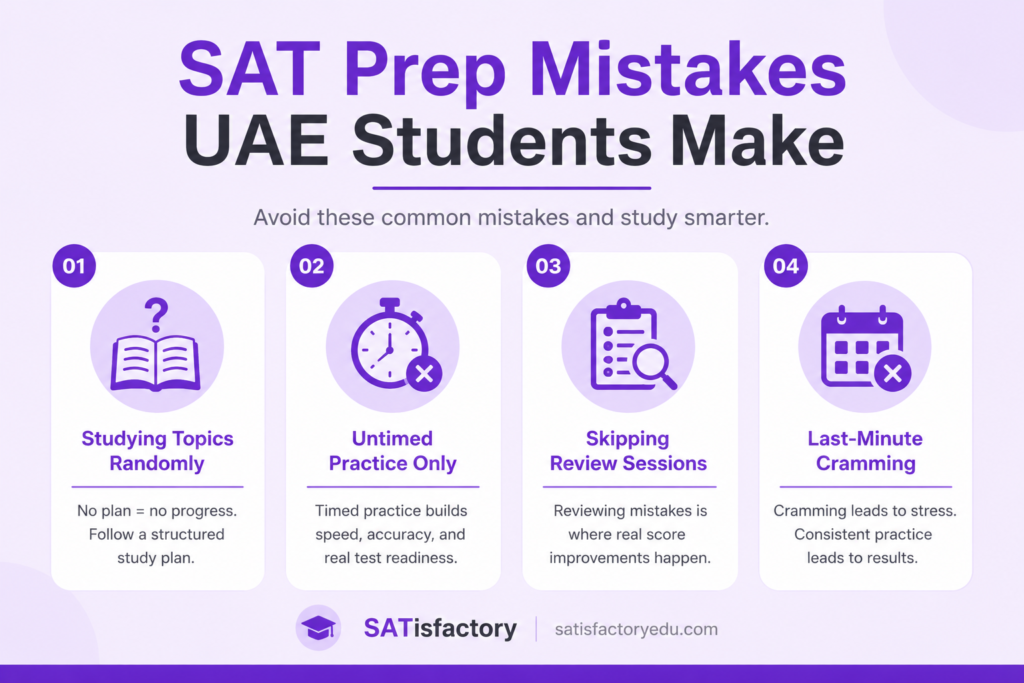
Most of the SAT prep mistakes UAE students make are not about effort. They come from how that effort is directed.
1. Studying topics in the wrong order
Students often start with whatever topic feels most familiar rather than what the diagnostic test flagged as weakest. Practice time is most valuable when it targets the topics costing the most points, even if they feel less comfortable to study.
2. Doing only untimed practice
Working through problems without a timer builds understanding, but the Digital SAT is a timed, adaptive test. Without regular timed practice, students often know the content but run out of time or make careless errors under pressure they have not trained for.
3. Skipping the review step
Finishing a practice test and moving straight to the next one without reviewing wrong answers means the same mistakes repeat. A short review session after every practice set is where most of the actual score improvement happens.
4. Cramming in the final two weeks
A heavy final push right before test day often leaves students mentally fatigued on test morning. The final two weeks should taper toward lighter, full-length practice and rest, not the heaviest study load of the entire plan.
What Results Can a Structured SAT Preparation Plan Support?
Students who follow a structured preparation plan can make substantial score gains when their study is matched to their starting point, target score, and available time. SATisfactory examples include a 1600 score from a Brighton College Al Ain student and 1570 scores from students at Dubai International Academy and Faips DPS Kuwait.
The common thread is not simply the number of tests taken. It is a multi-month study plan built around targeted practice, timed checkpoints, and consistent review of mistakes.
None of these students started with a 1500+ baseline. Each followed a multi-month SAT study plan built around timed Bluebook practice, regular SmartMocks, and consistent review of mistakes. Students outside the UAE follow the same structure, including those taking our SAT course in Kuwait. SATisfactory Education is a UAE-based SAT prep platform, featured in Khaleej Times and rated 4.9 by students and parents across the GCC.
Start Your SAT Prep Plan Today
If you are ready to turn this guide into an actual plan, the first step is a free SmartMock. It mirrors the real Bluebook adaptive experience and gives you a full section-level score breakdown in under two hours, so you know exactly where to focus.
Or if you would rather talk it through first, book a free 30 minute demo with a SATisfactory tutor. No commitment, no pressure, just a clear plan based on your target date and current score.
Book a Free Demo | Try a Free SmartMock