

What Topics Does SAT Math Actually Cover?
Every question on SAT Math falls into one of four domains, and College Board publishes the exact weighting of each one. Algebra and Advanced Math together make up about 70% of the section, which is worth knowing before you decide where to spend your study hours.
- Algebra checks whether you can read, build, and solve linear equations, inequalities, and systems of them, including what a line’s slope and intercept actually tell you.
- Advanced Math tests how comfortable you are with equations and functions that aren’t straight lines: quadratics, exponentials, absolute value, and other nonlinear relationships.
- Problem-Solving and Data Analysis measures how well you reason through ratios, rates, percentages, and real data sets, tables, graphs, and scatterplots included.
- Geometry and Trigonometry covers area, volume, angle relationships, triangle properties, circles, and basic right-triangle trig.
Each domain also breaks down into specific skills College Board tests on every form of the exam:
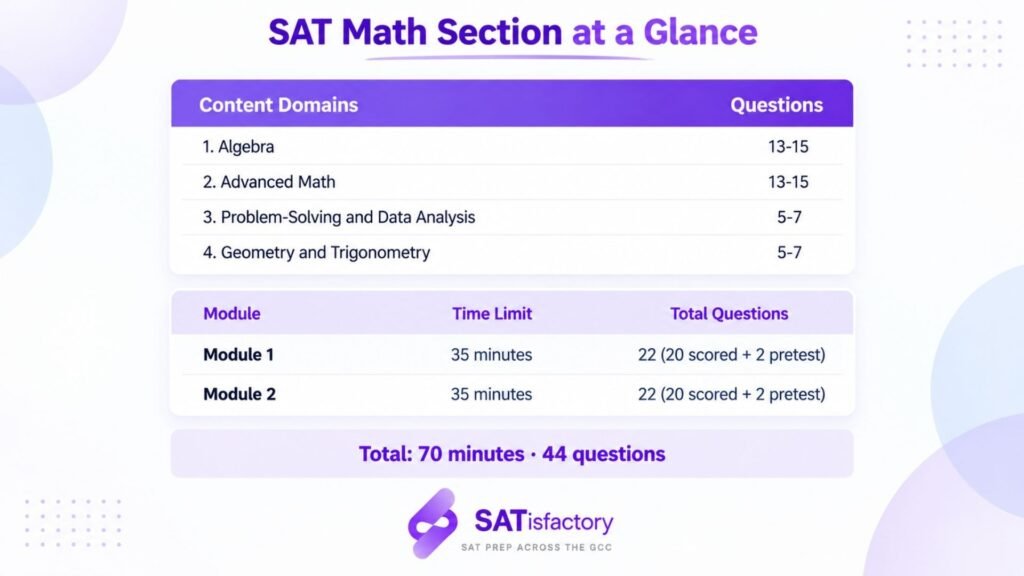
| Domain | Skills Tested | Share of the Section |
|---|---|---|
| Algebra | Linear equations in one variable Linear equations in two variables Linear functions Systems of two linear equations in two variables Linear inequalities in one or two variables | About 35% (13 to 15 questions) |
| Advanced Math | Equivalent expressions Nonlinear equations in one variable and systems of equations in two variables Nonlinear functions | About 35% (13 to 15 questions) |
| Problem-Solving and Data Analysis | Ratios, rates, proportional relationships, and units Percentages One-variable data: distributions and measures of center and spread Two-variable data: models and scatterplots Probability and conditional probability Inference from sample statistics and margin of error Evaluating statistical claims from studies and experiments | About 15% (5 to 7 questions) |
| Geometry and Trigonometry | Area and volume Lines, angles, and triangles Right triangles and trigonometry Circles |
About 15% (5 to 7 questions) |
That’s the full SAT Math syllabus. It doesn’t change from one test date to the next, only the specific questions do, so a study plan built around these four domains stays useful for as long as you’re prepping. Students going through structured SAT prep in Dubai usually see the fastest score jumps by front-loading Algebra and Advanced Math, simply because those two domains carry twice the weight of the other two combined.
How Many Questions Are on the SAT Math Section?
SAT Math has 44 scored questions across two modules, 22 questions each, with 35 minutes per module. That’s 70 minutes total, and the clock runs per module, not per section, so finishing Module 1 early doesn’t hand you extra time in Module 2.
| Module | Questions | Time |
|---|---|---|
| Module 1 | 22 | 35 minutes |
| Module 2 | 22 | 35 minutes |
| Total | 44 | 70 minutes |
Two questions in each module are unscored pretest items that College Board uses to trial future questions. You won’t be able to tell which ones they are, so every question gets treated as if it counts.
The Digital SAT is also adaptive at the module level. How you perform on Module 1 decides whether Module 2 comes back easier or harder, and a harder Module 2 actually caps out at a higher possible score. That’s one of the biggest differences from the old paper test, and it changes how pacing should work in Module 1 specifically: getting the early questions right matters more than most students expect.
What Are the SAT Math Question Types?
SAT Math questions come in two formats: multiple-choice and student-produced response, usually shortened to SPR. Multiple-choice questions give you four answer choices, and since there’s no penalty for guessing, leaving one blank is always the wrong call.
SPR questions ask you to type in your own answer instead of picking one. They make up roughly a quarter of the section, accept both decimal and fraction formats, and carry no partial credit. There’s no room for a complex expression as an answer here, just a specific value, and you either land on it exactly or you don’t.
That difference matters for how you spend your 95 seconds. Multiple-choice questions let you work backward from the answer choices when you get stuck on a tricky SAT Math problem. SPR questions don’t give you that option, so it’s usually smarter to attempt them early in a module rather than saving them for the end.
Can You Really Use a Calculator for All of SAT Math?
Yes. The Digital SAT allows a calculator on every single question in the Math section, either a student’s own approved device or the built-in Desmos graphing calculator inside the Bluebook testing app. That’s different from the old paper SAT, which had a no-calculator module, and it’s one of the more student-friendly changes in the current format.
Desmos does more than basic arithmetic if you know where to look. Typing an equation straight into the graph window shows its x-intercepts, which is often faster than solving algebraically on a question that only asks where a line or curve crosses zero. It can also run a quick regression on a two-variable data question, and plugging an answer choice back into the original equation is usually faster than re-deriving it by hand when you’re not fully confident in your work.
The test also provides a built-in formula sheet covering area and perimeter of common shapes, volume and surface area of 3D figures, properties of special right triangles, and basic trigonometric ratios. Having it available doesn’t mean it’s free to ignore during prep. Most students still memorize the SAT Math formulas ahead of time and treat the sheet as a backup, since looking something up mid-question costs seconds you don’t have.
What Formulas Are on the SAT Math Reference Sheet?
The reference sheet is built around the SAT Math formulas that are easy to blank under pressure, not the ones you’re expected to already know by heart. Algebra and Advanced Math rules, like factoring a quadratic or solving a system of equations, aren’t on it. Geometry and a handful of core measurement formulas are.
Area, perimeter, and circles
- Rectangle: A = lw
- Triangle: A = ½bh
- Circle: A = πr², circumference = 2πr
- A full circle contains 360°, or 2π radians
Volume
- Rectangular prism: V = lwh
- Cylinder: V = πr²h
- Sphere: V = (4/3)πr³
- Cone: V = (1/3)πr²h
- Pyramid: V = (1/3)(base area)(height)
Triangles and angles
- Pythagorean theorem: a² + b² = c²
- The interior angles of any triangle add up to 180°, and any quadrilateral’s add up to 360°
- A 45-45-90 triangle has sides in the ratio 1 : 1 : √2, and a 30-60-90 triangle has sides in the ratio 1 : √3 : 2
A quick way to check whether you’ve actually memorized this list: cover the sheet and try to write every formula on it from memory in under two minutes. Whatever you can’t reproduce is the exact set to drill this week, not the whole syllabus.
How Is SAT Math Scored?
SAT Math is scored on a 200 to 800 scale, based on a raw score out of 40 operational questions converted through an algorithm College Board doesn’t publish in full. Since every test form uses different questions, the exact conversion shifts slightly from one exam date to another, which is why two students with the same number of correct answers can occasionally land on slightly different scaled scores.
This section carries weight beyond the college application itself for students in the region. The UAE Ministry of Education’s equivalency process for an accredited high school diploma currently includes a minimum SAT Math requirement, alongside English proficiency scores, for students going through the SAT exam in UAE pathway. That makes this section relevant even for students who aren’t necessarily targeting a highly selective US university.
The Digital SAT itself has run in this exact 44-question, two-module format since it replaced the paper test in March 2024, so the structure you’re studying today is the same one every recent applicant has already been through.
Your official score report also breaks performance down by these same four domains, showing roughly how you did in each one rather than a single Math number on its own. That’s the fastest way to tell whether a lower score came from geometry gaps specifically or was spread evenly across all four areas, and it’s worth checking after every practice test, not just the real exam.
What Strategies Can Help You Solve SAT Math Problems?

Start with the obvious one: answer every question. There’s no penalty for a wrong guess on the Digital SAT, so an educated guess always beats a blank, and it’s one of the simplest SAT Math strategies to apply under pressure.
On multiple-choice questions, the cross-out tool is worth using deliberately, not just when you’re completely stuck. Starting from a 25% chance of a random correct guess, eliminating one wrong choice moves you to 33%, and eliminating a second moves you to 50%. College Board also likes to pair similar-looking wrong answers together, so if you can rule out one member of a pair, say an expression that only differs from another by a plus or minus sign, you can often eliminate both in one move.
Time management looks different for SPR questions. Since they offer no partial credit and no way to work backward from choices, it’s worth giving them a firm cap of about two minutes each and moving on if you hit it, rather than losing three or four minutes chasing one answer.
Formatting trips up more students than the actual math. The answer box won’t take a mixed number, so three and a half has to go in as 7/2 or 3.5, never as “3 1/2,” which Bluebook reads as the fraction 31/2. Fractions also don’t need to be reduced first: typing 6/8 scores exactly the same as 3/4. Get into the habit of glancing at the answer preview before submitting, since a stray space or slash in the wrong spot won’t throw an error, it’ll just mark the answer wrong.
The same time-capping and formatting rules apply everywhere the exam is administered, whether a student is going through SAT preparation in Saudi Arabia or prepping anywhere else in the GCC; the domains tested and the time pressure are identical no matter where College Board runs the exam.
Not Sure Which Strategy Fits Your Weak Spots?
Elimination and time-capping work differently depending on which domain is actually costing you points, and that’s usually easier to spot with a second set of eyes on your practice sets.
How Should You Structure Your SAT Math Prep?
“Ways to Prepare” is half the promise of this guide, and that side comes down to sequencing more than raw hours logged. Studying every domain at once for months rarely beats a shorter, ordered plan built around how the section is actually weighted.
A four to six week runway is realistic for most students who’ve already finished Algebra 2, longer if Geometry or Advanced Math still feel shaky. Here’s a structure that holds up for most students working through it:
| Week | Focus | What “Done” Looks Like |
|---|---|---|
| Week 1 | Diagnostic, then Algebra | A full timed Bluebook diagnostic, then domain drills targeting whatever it flagged in Algebra |
| Week 2 | Advanced Math | Quadratics, exponentials, and nonlinear functions, since this domain carries the same weight as Algebra |
| Week 3 | Problem-Solving and Data Analysis, Geometry and Trigonometry | Both smaller domains together, since each is worth roughly half of Algebra or Advanced Math alone |
| Week 4 | Full timed modules | Two full timed Math modules a week, with every miss reviewed the same day instead of batched later |
| Week 5-6 (if needed) | Targeted repair | One more pass on whichever domain is still costing the most points, then a final diagnostic to confirm the gap actually closed |
The order matters more than the exact number of weeks. Algebra and Advanced Math come first because they’re 70% of the section, Geometry and Data Analysis come next because they’re contained enough to fix quickly, and full timed practice comes last because pacing only improves once the underlying math is already solid.
What Mistakes Cost the Most Points on SAT Math?
Most point loss on SAT Math doesn’t come from not knowing the math. It comes from a handful of repeatable habits that show up on practice test after practice test once you start reviewing for patterns instead of just scores.
- Rushing the easy questions. Since Module 1 determines your Module 2 difficulty, a careless mistake on an early question costs more than the same mistake later on. Slow down slightly through the first third of each module.
- Under-using the on-screen tools. The built-in Desmos calculator can graph, solve systems, and check an answer by plugging it back in, but plenty of students only reach for it on questions that mention a graph outright.
- Answering the wrong thing. A question might be solved for y and then ask for the value of 2y, or ask what makes an equation have no solution rather than exactly one. Reading the question’s last line again after solving catches this before it costs a point.
- Skipping the review pass. Flagging a question for review only helps if there’s time left to come back to it, which means the first pass through a module should move a little faster than feels comfortable on the easier items.
None of these come down to knowing more math. They come down to the version of a student that exists an hour into a timed module, not the version that exists during untimed practice, which is exactly why full-length, timed drills matter as much as reviewing content.
How Can You Practice SAT Math Questions Effectively?
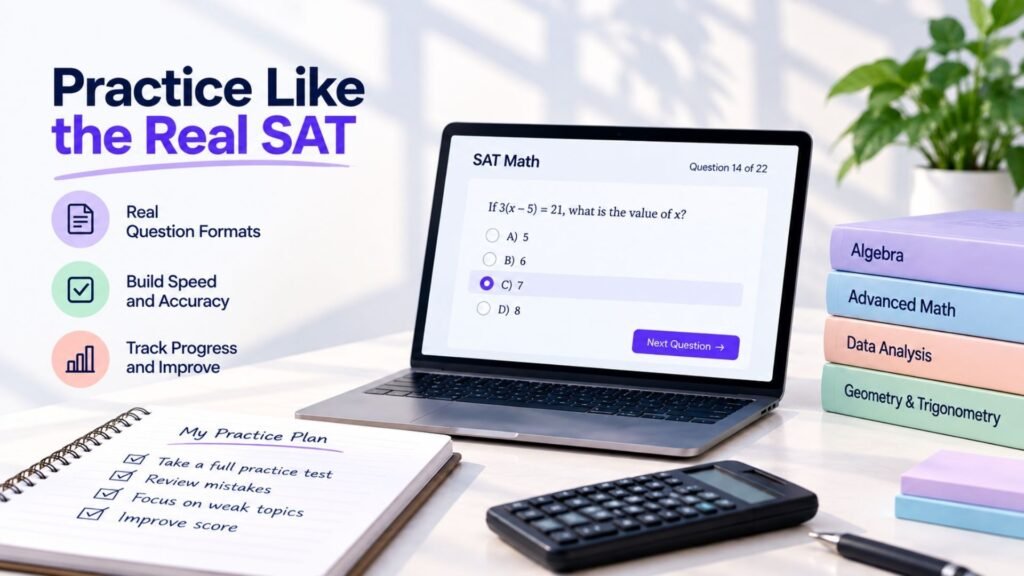
The most useful SAT Math practice starts with a real diagnostic, not a guess at which domain needs work. College Board’s own Bluebook app runs full-length, adaptive sat practice tests that mirror the actual test-day experience down to the interface, and a timed SAT Math practice test through Bluebook is the closest simulation available before test day itself.
From there, working through Algebra and Advanced Math sets specifically, since they carry 70% of the section, tends to build accuracy faster than mixed drills. Once accuracy holds up, switching to full timed modules builds the pacing muscle that domain-by-domain practice can’t. Reviewing every missed question afterward, including the ones missed from a careless slip rather than a knowledge gap, is usually what separates students who plateau from students who keep climbing.
Want to Try a Few SAT Math Questions Right Now?
Reading about the format only gets you so far. Try the five questions below, check your answer against the explanation either way, and pay attention to which domain gave you the most trouble.
1. A right triangle has legs of 6 and 8. What is the length of its hypotenuse?
A) 9 B) 10 C) 12 D) 14
Answer: B. This is the classic 6-8-10 right triangle. 6² + 8² = 36 + 64 = 100, and the square root of 100 is 10.
2. If 3(x − 4) = 2x + 5, what is the value of x?
A) 7 B) 9 C) 13 D) 17
Answer: D. Distribute to get 3x − 12 = 2x + 5, then subtract 2x from both sides to get x − 12 = 5, so x = 17.
3. Which of the following is equivalent to x² − 5x − 14?
A) (x − 2)(x + 7) B) (x − 7)(x + 2) C) (x − 14)(x + 1) D) (x + 14)(x − 1)
Answer: B. You need two numbers that multiply to −14 and add to −5. That’s −7 and 2, so the expression factors to (x − 7)(x + 2).
4. A rideshare app charges a flat $3 booking fee plus $2 per mile. Amira’s trip costs $19. How many miles was the trip?
A) 6 B) 7 C) 8 D) 9
Answer: C. Subtract the flat fee: 19 − 3 = 16. Divide by the per-mile rate: 16 ÷ 2 = 8 miles.
5. A laptop priced at $800 is discounted 15%, and then an extra 10% is taken off the new price. What is the final price?
A) $600 B) $608 C) $612 D) $680
Answer: C. The first discount brings it to 800 × 0.85 = $680. The second discount applies to that new price: 680 × 0.90 = $612. The two discounts don’t just add to 25%, which is exactly the kind of detail Problem-Solving and Data Analysis questions like to test.
However you did on these five, take a full SAT Math practice test to see how that holds up under real timing and across all four domains at once.
Where Should You Go From Here?
If you already know Algebra and Advanced Math are shaky, that’s the honest place to start. If you’re not sure where you stand, a timed diagnostic will tell you faster than another week of scattered practice.
The fastest way to find out is to start a mock test and see exactly where your 70 minutes actually go, question by question, before you spend another week guessing at a study plan.