
What Is a Good SAT Score? National Percentile Context

Before ranking universities by tier, it helps to know where a given score sits nationally. The average composite SAT score lands in the low 1000s, so anything meaningfully above that already reads as above average against the general test taking population. A 1300 sits around the 87th percentile nationally. A 1400 sits around the 95th percentile, a genuinely strong score by any national measure, yet still below the 25th percentile at every Ivy League school. A 1500 climbs to roughly the 98th percentile, which is where a score finally sits comfortably inside the middle 50% at most elite schools. This is the gap UAE families often miss: a score that would be exceptional against the general population can still read as average, or below average, against the specific, self-selected pool applying to the most selective US universities. For many UAE students, the fastest percentile jumps come from Math, where a focused SAT Math Preparation Guide can convert an already strong foundation into a near maximum section score faster than equivalent gains in Reading and Writing.
SAT Score Requirements by University Tier
Middle 50% ranges (where 25% of admitted students scored below and 25% scored above) give a far more realistic picture than any single “required score,” because most US universities never publish a hard cutoff.
| Tier | Example Universities | Typical Middle 50% SAT Range | 2026-27 Testing Policy |
|---|---|---|---|
| Ivy League and elite peers | Harvard, Yale, Penn, Brown, Cornell, MIT, Stanford, Duke | 1480-1580 | Mostly required. Princeton and Columbia remain test optional for one final cycle. |
| Highly selective (Top 50) | NYU, Northeastern, Georgetown, Georgia Tech, Michigan | 1400-1570 | Mixed. NYU and Northeastern now require scores; several peers stay test optional. |
| Strong state flagships | UT Austin, UNC Chapel Hill, Purdue, Boston University, Wisconsin-Madison | 1300-1530 | Mostly test optional, though scores are still weighed heavily when submitted. |
| Accessible / broad access | Most regional and state universities | Below 1300 is competitive | Test optional or test blind at the large majority of these schools. |
Every row plays out differently on the ground. At the Ivy League tier, compiled Common Data Set figures put Harvard at roughly 1500-1580, Yale and Princeton near 1500-1570, Penn and Columbia around 1500-1560, and Cornell closer to 1450-1540, the most reachable of the eight. For students researching Ivy League SAT GCC requirements, a 1500+ target is a practical benchmark for highly competitive applications, although there is no universal Ivy League cutoff. No Ivy has a 25th percentile below roughly 1450, which means a 1400, a genuinely strong score at the 95th percentile nationally, still lands below the bar at every one of them.
The highly selective tier is where most ambitious UAE applicants compete. NYU’s admitted middle 50% runs approximately 1450-1570, and Northeastern sits close behind at 1430-1550, both having reinstated testing for fall 2026 entry after several test optional years. Strong flagships like Michigan, UT Austin, and UNC typically run 1360-1530, and here the SAT does more work for an international file than a domestic one, since it is a consistent benchmark across dozens of school systems. Families keeping a parallel option open through Universities in India accepting SAT will recognize a similar tiering logic, just calibrated to a lower absolute number, generally starting around 1300.
“The mistake we see every year is a student aiming for one score, as if 1450 works everywhere. It does not. Know your tier before you build your prep plan, not after.”
Do US Universities Still Require the SAT for International Students?

This is where most UAE families get anxious, because the honest answer is “it depends,” and that ambiguity makes students hesitant to commit prep time to a test that might not be required.
Fair Test tracks more than 1,800 four-year US colleges still running test-optional or test-blind policies, and over 90% of four-year schools will not require scores for fall 2026 admission. But that statistic hides the trend that matters most for ambitious applicants: testing requirements are returning hardest at the top of the rankings. For UAE students researching the MIT SAT score UAE applicants should target, MIT is among the highly selective universities where a strong SAT result remains important. Similarly, students comparing Ivy League SAT GCC requirements should understand that the most competitive Ivy League applications generally require scores that sit near the top of the national testing range. MIT, Harvard, Yale, Stanford, Dartmouth, Georgetown, Caltech, and Purdue all require SAT or ACT scores for the current cycle, and Common App data shows nearly 784,000 students submitted scores this past cycle, a jump even at schools where submission stayed optional. Students who submitted scores under test-optional policies have historically been admitted at meaningfully higher rates than those who withheld them.
For UAE applicants, the practical rule is simple: if any school on your list requires testing, plan to sit the SAT. Treating “test optional” as “test irrelevant” removes a tool that lets admissions officers compare a UAE curriculum directly against a US, Indian, or European one on a shared scale. The same test optional versus test required split shapes how families researching SAT Coaching in Saudi Arabia approach the decision, since the underlying College Board policy is identical across every GCC country.
Score submission warning: middle 50% ranges cut both ways. If your diagnostic or actual score sits at or above a school’s published range, submit it, even where testing is optional, since submitted scores in that band tend to help. If it sits meaningfully below the range, a test optional school usually reads the absence of a score more favorably than a below-range one. The decision to submit is a score-by-score, school-by-school call, not a blanket policy.
Superscoring and Score Choice: Why Your Target Number Might Be Lower Than You Think
Most selective universities superscore, combining your best Reading and Writing score and your best Math score across different test dates rather than judging one sitting’s composite. Score Choice then lets you decide which sittings to send. A student who scores 730 Math on one date and 700 Reading and Writing on a later date can often submit a superscored 1430, though neither sitting reached that number alone. Policies vary by school, but where it applies it changes how hard a student needs to chase one perfect sitting, and it is part of why a second attempt after targeted prep is usually worth planning for from the start rather than treated as a fallback.
SAT Score Requirements for Scholarships and Merit Aid
SAT score requirements are not only an admissions filter, they often set the price of the degree itself. A large number of US public universities award automatic merit scholarships once a submitted score clears a published threshold, with no separate application required. The University of Alabama is a well known example: its published international merit scale rewards higher SAT bands with progressively larger awards, and similar automatic tiers exist at dozens of other state schools. As a rough guide, scores in the 1200 to 1400 range typically unlock entry level merit aid at large public universities, 1400 to 1500 opens access to more generous packages, and 1550 and above is where near full tuition or full ride awards start to appear, almost always paired with a strong GPA. For UAE families weighing a US degree against a UK or Indian alternative, this scholarship layer is often the more decisive number, since two students admitted to the same university can end up paying very different tuition based on the SAT band they cleared.
3 SAT Score Targeting Mistakes UAE Students Make
Chasing one number instead of a tier. A 1450 is excellent for a strong state flagship and below range at four of the eight Ivies. Set your target per school, not per rumor.
Withholding a strong score out of habit. Some students skip submitting at test optional schools by default, even when their score sits at or above the published range. That instinct protects a weak score; it also quietly costs a strong one.
Sitting the test once and stopping. Superscoring rewards a second attempt. A single flat sitting rarely reflects true ability, and one retake after targeted prep is standard, not excessive.
Close the Gap Between Your Score and Your Target Tier
A published middle 50% range tells you where you need to land. It does not tell you how far your current score is from that number, and that gap, not the raw target, is what actually determines your prep timeline. A student sitting at 1250 aiming for a 1500 Ivy target and a student sitting at 1400 aiming for the same number are running two completely different projects, even though the finish line looks identical on paper.
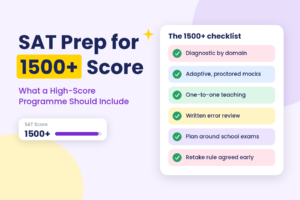
SATisfactory’s PlanPilot tool starts from a full length diagnostic, benchmarks it against the specific tier a student is targeting, and reverse engineers a study plan sized to that exact gap rather than a generic timeline. SmartMocks then track whether practice scores are actually closing the gap under real adaptive Bluebook conditions.
SATisfactory is a UAE based SAT prep platform, featured in Khaleej Times and rated 4.9 by students and parents across the GCC. Book a free 30 minute demo to see where your current score sits against the tier you are targeting, no commitment required.
Or take a free SmartMock today and get a full section level score breakdown in under two hours.